Why the Stage Version and the Dance Practice Video Are Not the Same Choreography
Quick Answer: Dance practice videos are filmed in one continuous wide shot with full-body visibility and standard spacing — ideal for learning. Stage versions are cut across multiple cameras, use different formations sized to the venue, and frequently include stage-specific changes: adjusted timing for live vocals, altered arm heights for costumes, and moves modified for props or camera angles. Learn from practice, refine from stage, never the reverse.
You spent two weeks on the dance practice video. You know every count. Then you watch the music show performance to check yourself and it looks like a different routine.
The arms are lower. There is a spin that was not there. Somebody is standing where nobody stands.
You did not learn it wrong. You learned the version that exists to be learned, and then compared it to a version that exists to be broadcast.
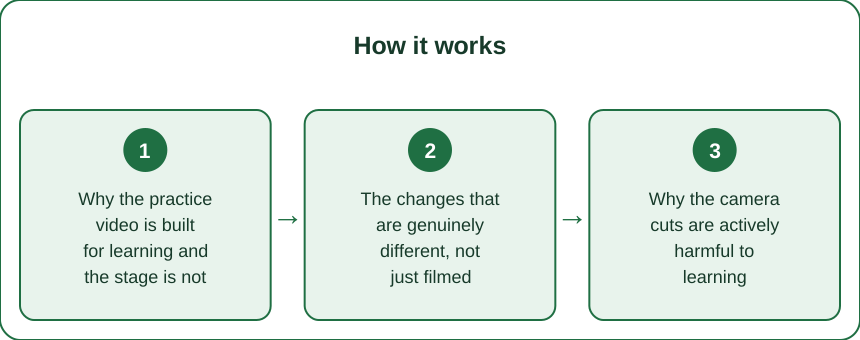
Why the practice video is built for learning and the stage is not
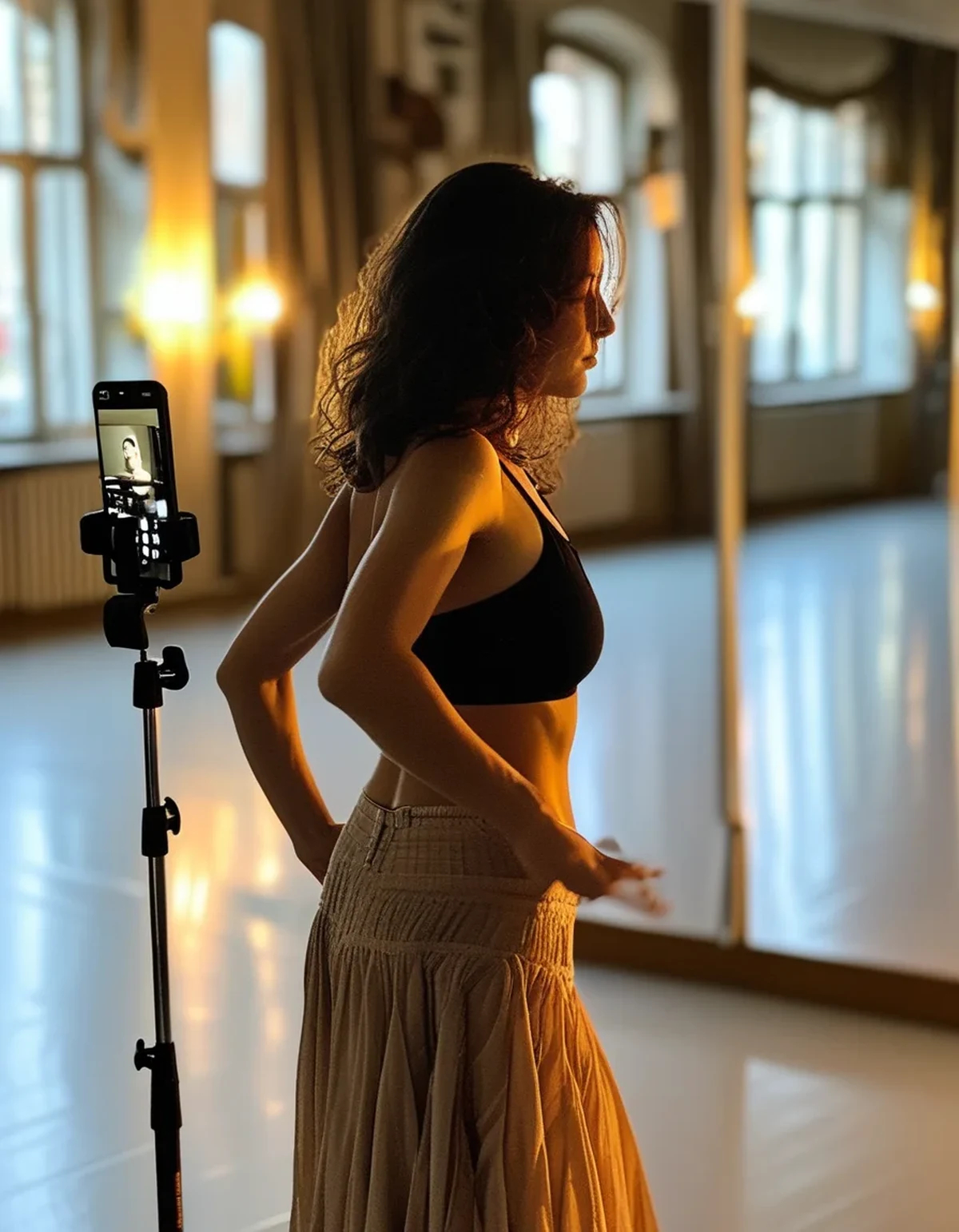
Dance practice videos are a deliberate format with consistent conventions, and every one of them favours the learner.
One continuous take, one fixed wide camera. No cuts means you can follow a single dancer from start to finish. This is the single most important property, and it is the one stage versions destroy.
Full body always visible. You can see the feet. Feet are where most choreography actually lives, and they are the first thing a broadcast director crops.
Even, generous spacing. Practice rooms use standard formations that show every member. Stages compress or expand these to fit the venue and the camera.
No costume interference. Practice clothes reveal the body line. Stage costumes hide it, and sometimes change it — a long coat, a wide sleeve or a skirt alters what a move looks like even when the move is identical.
Consistent lighting. Stage lighting is designed for atmosphere, not legibility, and dark sections of a performance can hide entire eight-counts.
The practical rule: the practice video is the source of truth for what the choreography is. The stage version is the source of truth for how it should feel.
The changes that are genuinely different, not just filmed differently
Some differences are real modifications, and knowing which is which saves a lot of confusion.
Live vocal adjustments. Moves that restrict breathing get softened or removed for members singing live. A deep fold or a fast spin before a sustained note is frequently changed on stage. This is why the same member sometimes does a different version than in the practice room.
Formation changes for venue size. A music show stage, an arena and a festival stage all have different dimensions and camera positions. Formations get widened, compressed or rotated to face the main camera. The spacing you learned is often simply not the stage spacing.
Camera-facing angles. A move done at 45 degrees in the practice room may be squared to the front on stage so the camera reads it. This changes which direction you turn and can genuinely confuse your muscle memory.
Prop and costume accommodations. Chairs, microphones, capes and hats all impose changes. A hand that goes to the hip in practice may go to a hat brim on stage.
Wear-in drift. Choreography evolves over a promotion cycle. The performance in week one and the performance in week six of the same song often differ in small ways as the group settles into it.
Why the camera cuts are actively harmful to learning
This deserves its own section because it is the thing that most reliably breaks people’s learning.
A broadcast performance cuts between cameras every two to four seconds on average. Each cut changes angle, distance and often which member is in frame.
What that does to your brain: you are trying to build a continuous motor sequence, and the visual input is discontinuous. Your brain has to stitch together fragments filmed from different positions, which is a genuinely difficult spatial task and one that produces errors.
Worse, the cuts land on the interesting moments. Directors cut to a close-up on the big beat, which is exactly the count you needed to see the feet on.
And close-ups remove the reference frame. A close-up on a face tells you nothing about where the body is in space.
Practical consequence: you can watch a stage version fifty times and never see one member’s full body through one complete eight-count. That is not a viewer problem; it is a broadcast format working correctly for its actual audience.
What Nobody Tells You: the fancam is the missing piece
The format that solves this is neither the practice video nor the broadcast version.
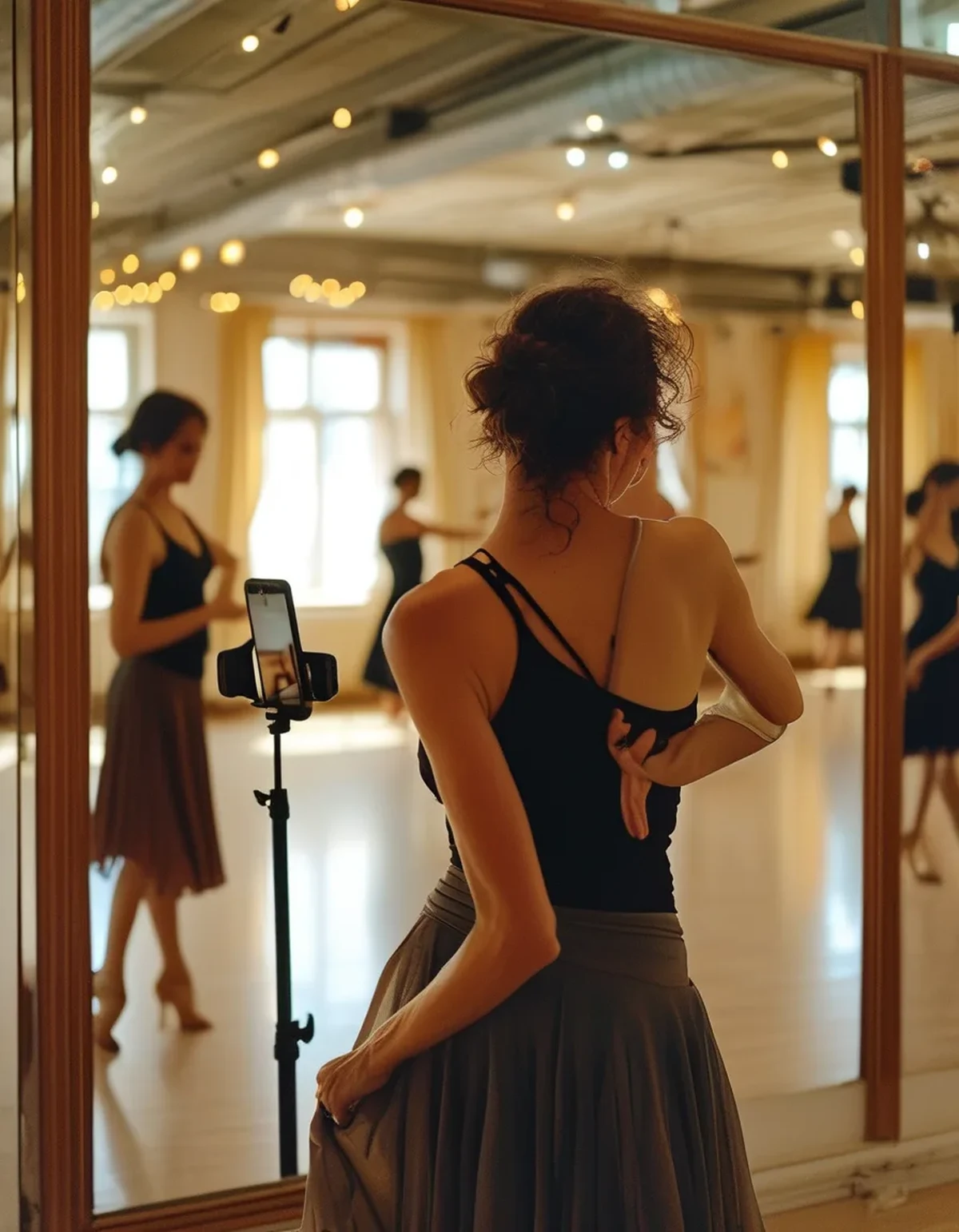
A fancam — a single fixed camera following one member for the whole song — gives you what both other formats lack: continuous footage of one person, in costume, on stage, at performance energy.
Why it matters for learning: the practice video shows you the shape. The fancam shows you the shape performed properly, with the stage timing, the costume drape, and the actual energy level. It is the bridge between knowing the moves and performing them.
How to use the three formats in order:
- Practice video — learn the choreography. Wide, continuous, full body. This is 80 percent of your time.
- Fancam of your position — refine timing, energy and the stage-specific version. Choose a fancam of the member whose part you are covering.
- Broadcast version — study formations and transitions only. Watch it as a map of where people go, not as a source for the moves.
One more use for fancams: because they are filmed from the audience at an angle, they show you what the choreography looks like from the side. Side views expose depth and body angle in ways a front-facing practice video cannot.
How to reconcile the two versions without redoing everything
When you notice a difference, run this sequence rather than panicking.
Ask first: is this a camera difference or a movement difference? Find a fancam or a second stage performance from another angle. Most apparent differences are the camera.
Check two or three separate performances. If the change appears in all of them, it is the stage version. If it appears in one, it was a one-off adjustment or a mistake.
Default to the practice video for the moves and the stage for the feel. Arms lower on stage is almost always about costume and camera, not about the choreography being different.
Do not chase formation changes if you are dancing alone. Formations are a group property. Learning them is useful if you plan to perform with others and a waste of time if you do not.
And accept that some things are unresolvable. Sometimes a member does something slightly different because it suits their body, and there is no correct version. Pick one, commit to it, and stop watching in slow motion at 2 a.m.
This is general information about learning choreography. Any dance training brings injury risk — warm up properly, and treat persistent joint pain as a reason to see a professional rather than to practise more.
FAQ: Stage Versus Practice Video, Answered
Which should I use if I am filming my own cover?
Learn from the practice video, then match the energy and styling to whichever stage version you like best. Most covers that look flat learned only from practice footage and never absorbed the performance quality.
Why do the arms look lower on stage?
Costumes, mostly — heavy sleeves, jackets and accessories change what feels natural — plus the fact that a full-out stage performance with live vocals is more physically demanding than a practice room run. Slight softening at performance intensity is normal, not a different choreography.
Should I mirror the practice video?
If you plan to face an audience, learn it unmirrored and mentally flip, or use a mirroring app. Learning mirrored from an unmirrored source and then trying to reverse it later is one of the most common ways to lock in a confusion that takes weeks to unpick.
TL;DR:
- Practice videos are one continuous wide shot with visible feet and standard spacing — the format exists to be learned from.
- Stage versions cut every two to four seconds, crop the feet, and hide the body in costume and lighting.
- Some differences are real: live vocal adjustments, venue-sized formations, camera-facing angles and prop accommodations.
- Fancams are the missing bridge — continuous, single-member, in costume, at performance energy.
- Learn from practice, refine from fancam, use broadcast only as a map of formations.
You did not learn it wrong. You learned it from the version designed for learning, and then checked your work against the version designed for television.
Keep Reading
This article is for general informational and styling purposes only. Fit, sizing, and product availability may vary.