Why Your Body Feels Stiff in the First Run-Through Every Time
Quick Answer: Your first run-through is a warm-up whether you intended it or not. Muscle temperature, tissue compliance, and neural readiness all need several minutes of movement, and choreography demands large ranges and fast direction changes from the very first count. In a cold practice room, that gap widens - the third run feels dramatically better because by then you are actually warm. A structured eight to twelve minute warm-up before the first run gets you to third-run quality on run one, which is worth roughly one extra good repetition per session.
This matters more than it sounds: your first run is often the one you film.
What is actually different about run one?
Muscle temperature is lower, which reduces contraction speed and force production. Choreography is full of fast accents, and accents are the first thing to look weak.
Tissue compliance is lower, so extensions do not reach and hip mobility feels restricted.
Neural readiness lags. Motor recruitment improves over the first few minutes of activity - the coordination itself improves, not just the muscles.
You have not rehearsed transitions in this session yet. Memory of a sequence needs a retrieval pass, and run one is that pass regardless of how well you know it.
Breathing is not settled. Most choreography is anaerobically demanding and the first run is where breath control is worst, which affects timing and sharpness.
And your body position sense is calibrated to sitting, not to dancing. Spatial accuracy - formations, arm lines, facing - improves measurably after a few minutes of movement.
What should the warm-up include?
Three minutes of general cardiovascular work. Marching, light jogging, jumping jacks. Getting warm is the priority and it is boring and it works.
Then dynamic mobility for the specific demands. Hip circles, thoracic rotations, shoulder swings, ankle work. K-pop choreography is heavy on hips, thoracic spine, and shoulders.
Then isolations at increasing speed. Chest, shoulders, hips, head. This is dance-specific and it addresses control as well as temperature.
Then one slow walkthrough of the hardest eight counts, marking rather than performing.
Then run it. Total eight to twelve minutes, and it converts run one from a throwaway into a usable take.
Skip long static stretching before dancing. Long holds immediately before explosive movement slightly reduce power output, and they do nothing for tissue temperature. Save them for the end.
Why is it worse in autumn?
Practice rooms are colder, and home practice spaces particularly so. Muscle temperature is the whole mechanism and a cold room works directly against it.
You arrive colder. A cold commute constricts peripheral circulation, and it takes several minutes to reverse.
Floors are colder, which matters for floorwork and for anything barefoot.
Clothing changes range of motion. Layers restrict shoulder and hip range, and a hoodie noticeably changes arm lines.
Practice sessions move later in the day as evenings darken, and later sessions start from a more fatigued baseline.
And people cut warm-ups when they are cold because standing around doing hip circles in a cold room is unpleasant. That is exactly backwards and it is the most common autumn error.

What Nobody Tells You About Run-Throughs
Runs three and four are usually your best, and runs six onward decline. Most people film run two and stop after run eight - both are suboptimal.
Filming changes your performance. People perform larger and slightly rush when a camera is on, which is worth knowing when comparing a filmed run to a practice run.
Fatigue shows in the arms before the legs. Arm lines drop and become less precise several runs before footwork degrades, which is why later takes look tired even when the choreography is correct.
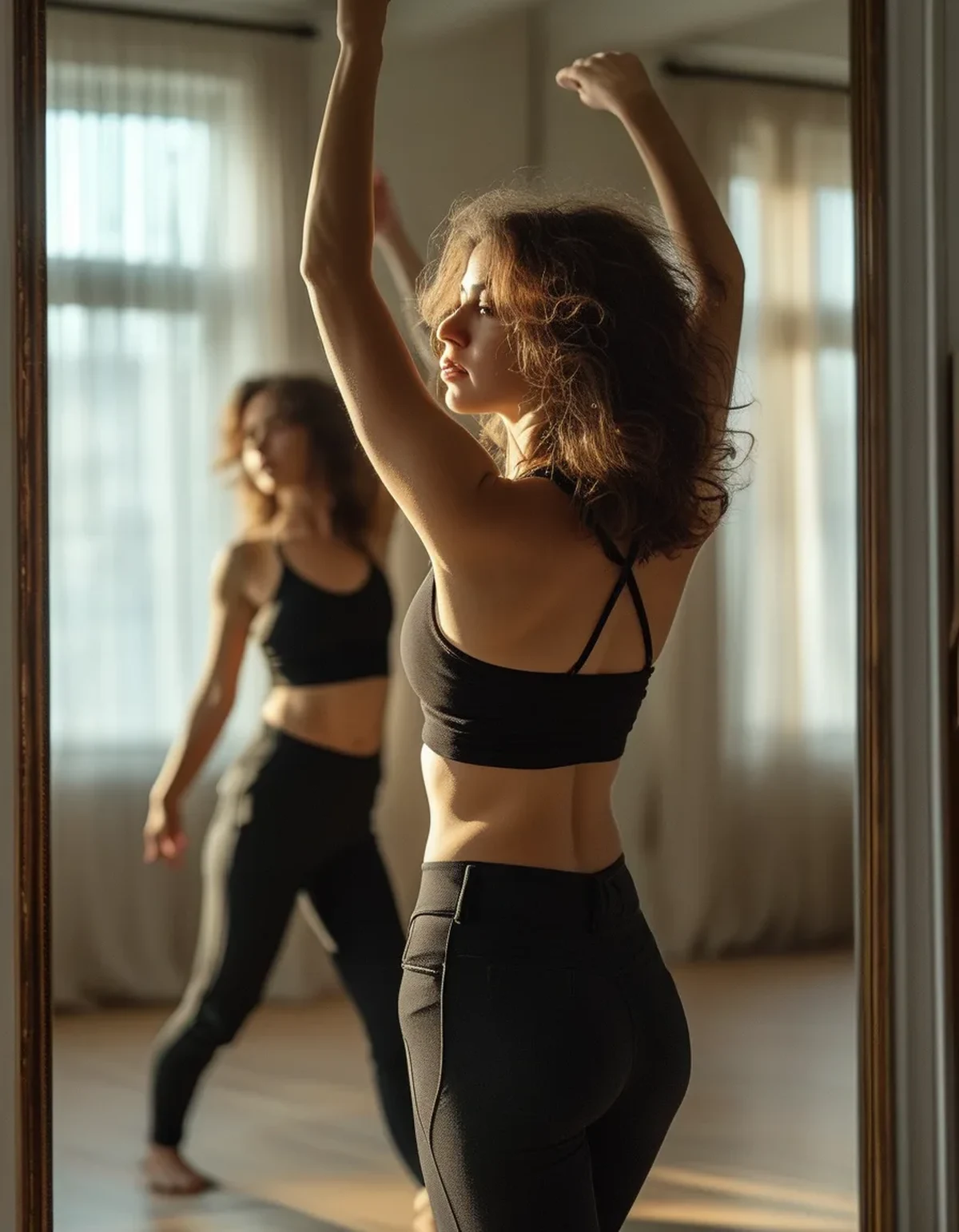
Mirror practice and camera practice produce different results. Mirror work improves shape awareness but trains you to look at yourself; camera work trains front-facing performance. Both are needed and most people do only one.
Learning new choreography is best done early in a session, right after the warm-up, because motor learning degrades with fatigue faster than performance does.
And the last run of a session is the one your body remembers most. Ending on a sloppy tired run reinforces sloppy patterns, so a good practice ends with an easier section done well rather than a hard one done badly.
How should a whole session be structured?
Warm-up: eight to twelve minutes.
New material: next, while fresh. Twenty minutes maximum on genuinely new choreography before returns diminish.
Full runs: three to five, with real rest between. Ninety seconds of rest is not indulgent, it is what allows the next run to be good.
Clean-up: one section, slowly, at the end. Detail work is better slow and fresh than fast and tired.
Cool-down and stretching: five minutes. This is where static stretching belongs, and it is the part that helps tomorrow’s session.
Total: forty-five to sixty minutes. Longer sessions produce more repetitions of increasingly worse quality, and quality is what gets stored.
FAQ: Warm-Ups and Run-Throughs, Answered
How long should I warm up before dancing?
Eight to twelve minutes, longer in a cold room. It converts run one from a warm-up into a usable take.
Should I stretch before practising?
Dynamic mobility yes, long static holds no. Static stretching immediately before explosive movement slightly reduces power.
How many full runs should I do?
Three to five with real rest between. Quality declines noticeably after that and poor repetitions reinforce poor patterns.
Which run should I film?
Run three or four, once you are properly warm but before fatigue affects arm lines.
Why does my body feel so different in a cold room?
Muscle temperature drives contraction speed and tissue compliance. A cold room works directly against both, and it is why the gap between run one and run three widens in autumn.
TL;DR:
- Run one is a warm-up whether you meant it to be - muscle temperature, tissue compliance, and neural readiness all need several minutes.
- An eight to twelve minute structured warm-up gets you third-run quality on run one, which is one extra good take per session.
- Do dynamic mobility and isolations, not long static holds - static stretching before explosive work slightly reduces power.
- Learn new choreography right after the warm-up; motor learning degrades with fatigue faster than performance does.
- Three to five full runs with ninety seconds of rest beats eight tired ones, and arm lines fade before footwork does.
End on a section done well rather than a hard one done badly - the last run is the one your body remembers.
Keep Reading
This article is for general informational and styling purposes only. Fit, sizing, and product availability may vary.