Why Your K-pop Dance Cover Looks Flat Even With Perfect Footwork
You’ve drilled the choreo for three weeks. Every count is clean, the footwork is tight, the arms hit exactly where they should. You film it, watch it back, and something’s just… off. It looks like a very accurate tutorial, not a performance.
Look at your face in that video. There’s a decent chance it’s doing absolutely nothing.
Quick Answer: Facial expression in K-pop isn’t decoration added on top of choreography — it’s part of the choreography, built in from the start for close-up camera work. Your face goes blank because your brain is still spending its bandwidth on counts. Fix it by practicing expression as its own separate drill, reviewing it on video rather than in a mirror, and only folding it back into full-speed runs once the steps are automatic.

Is Facial Expression Actually Part of K-pop Choreography?
Yes — and treating it as optional is the core misunderstanding.
K-pop choreography is generally built around a specific emotional narrative. The routine isn’t a neutral sequence of shapes that you can perform happy, sad, or fierce depending on your mood. It was designed to convey something, and the face is one of the instruments carrying it, alongside the body.
Two things make this more true in K-pop than in most dance styles:
The camera is part of the design. A large share of K-pop choreography is created with the final video in mind — close-ups, center cuts, the moment the camera pushes in on one member during a specific line. When a routine anticipates a close-up, the face isn’t a supporting detail in that frame. It’s the entire frame. The body might not even be visible.
The original performance is a reference document. Pull up the official performance video of whatever you’re covering and watch only the faces during three or four specific sections. You’ll notice the expression changes are consistent across different performances of the same song, hit on the same counts, and match the lyric content. That consistency is the giveaway: these are choreographed decisions, not spontaneous ad-libbing. Which is good news — it means there’s something concrete to study and copy, not some vague “energy” you have to summon.
Why Does My Face Go Blank When I Dance?
Three reasons, and none of them are “you’re just not an expressive person.”
1. Cognitive load. While you’re still consciously thinking “five-six-seven-eight, arm, turn, drop,” your brain is spending its available attention on the hardest task in front of it. Facial expression is the first thing to get dropped, automatically, without you noticing. This isn’t a character flaw — it’s how motor learning works. Anything not yet automatic competes for the same limited pool of attention.
This has a direct implication: you cannot expression-train your way out of unfinished footwork. If the steps aren’t automatic, the face won’t hold. Learn the steps to automaticity first.
2. Self-consciousness. A lot of dancers feel noticeably more exposed doing a face than doing a body movement. A step is a technique; a facial expression feels like you. Making an intense or flirtatious face at your own reflection in an empty room is genuinely uncomfortable the first several times. Everyone goes through this. It fades with repetition, and it fades faster if you practice alone, without a mirror, in the early stages.
3. Practice imbalance. Here’s the plain math. Count how many minutes of your last practice session went to drilling steps. Now count how many went to drilling expression. For most people the second number is zero. One skill developed, the other stayed exactly where it was. You didn’t fail at expression — you never trained it.
How Do You Actually Practice Facial Expression?
Separately, on video, and last.
Isolate it from the choreography. Put the song on and don’t dance. Sit or stand still and run only the emotional beats — the shift into the chorus, the sharp look on the pre-chorus hit, the softness on the bridge. No footwork, no counts, no accuracy pressure. You’re building a vocabulary of expressions attached to specific moments in the music. Ten minutes of this is worth more than an hour of half-hearted face while you’re also thinking about your feet.
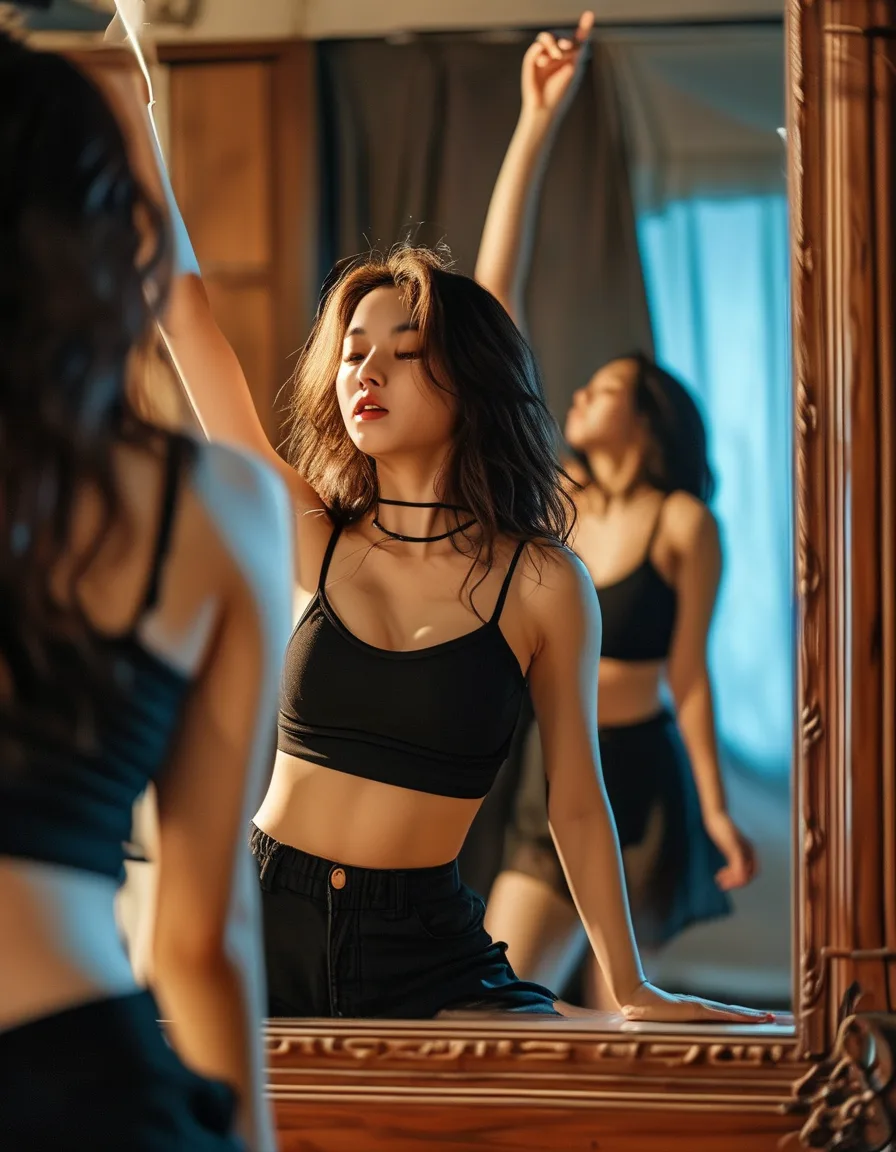
Review on video, not in a mirror. This is the one that changes results fastest. A mirror shows you what your face does when you’re looking at a mirror, which is a specific, slightly self-conscious expression that never appears in the actual performance. Worse, checking the mirror pulls your eyes and head out of position. Film a run, watch it back, and you’ll see what the camera actually sees — usually a much flatter face than you thought you were making. Almost everyone underestimates how much they need to project.
Add it back only when the steps are automatic. Run the choreography until you can do it while holding a conversation. That’s the threshold. Now there’s bandwidth free, and the expression you drilled separately has somewhere to live.
Myth vs Fact
Myth: Expression is something you either have or you don’t. Fact: It’s a trainable motor skill like any other. Idols rehearse specific expressions on specific counts. What reads as natural charisma on stage is usually a rehearsed decision that’s been repeated enough times to stop looking rehearsed.
Myth: If you feel the emotion, the right face will happen automatically. Fact: Feeling it and showing it are different skills, and the gap between them is enormous on camera. Plenty of dancers report feeling completely immersed in a run, then watch the footage and find a blank stare. Feeling is the input; projection is a separate output you have to practice.
Myth: Bigger expression always reads better. Fact: Bigger reads better for a wide shot; it can read as overacting in a tight close-up. The original performance is your calibration tool — match the intensity level the choreography was built for rather than maxing everything out.
Myth: You should practice expression in front of a mirror. Fact: Mirrors actively mislead here, for the two reasons above. Video is the only honest feedback for face work.
Myth: Work on expression once the cover is otherwise finished. Fact: That’s exactly the trap — expression is treated as a final coat of paint, gets ten minutes the night before filming, and looks like it. Train it in parallel from week one, just in isolation.
How Do You Make Expression Stick Permanently?
Attach it to counts, and rehearse the full package.
Tie a specific expression to a specific count or lyric, exactly the way footwork is tied to counts. Not “be fierce during the chorus” — “sharp eyes on count 3, soften on 7.” Vague emotional direction doesn’t survive contact with full-speed choreography. A cue attached to a number does.
Do performance run-throughs, not just technical run-throughs. These are different things. A technical run checks accuracy. A performance run rehearses the whole package — face, projection, energy, and steps together, as one thing you’d actually put in front of a camera. If every run you’ve ever done was technical, then the first time you perform the whole package is the take you’re filming. That’s not a rehearsal plan.
Aim for roughly one performance run for every three technical runs once the choreography is solid.
FAQ
How do I stop feeling awkward making faces while I dance?
Practice alone, without a mirror, filming instead. The awkwardness comes mostly from watching yourself in real time, and video review moves that discomfort to after the run instead of during it. It genuinely does fade — most dancers report it stops being an issue within a few weeks of consistent practice.
Should I copy the original artist’s expressions exactly?
Copy them first, then adjust. Studying the original teaches you where the expression changes belong and how intense they were designed to be, which is the hard part. Once those placements are in your body, adapting them to suit your own face and interpretation is natural and usually looks better than a pure imitation.
Does facial expression matter if I’m just dancing for fun at home?
Only if you want it to. But if you ever film yourself — and most people do — it’s the single biggest gap between a cover that looks technically correct and one that looks like a performance. It’s also cheap to train: ten minutes of isolated expression work per session, no extra space or equipment required.
TL;DR:
- Facial expression in K-pop is choreographed, built around close-up camera shots and an emotional narrative — not added on top.
- Your face goes blank because cognitive load eats it while you’re still counting steps. Get the footwork automatic first.
- Drill expression in isolation — song on, no dancing, just the emotional beats.
- Review on video, never in a mirror. Mirrors show you a self-conscious face that doesn’t exist in the actual performance.
- Attach expressions to specific counts, the same way you attach steps to counts. Vague emotional direction doesn’t survive full speed.
- Run roughly one full performance rehearsal for every three technical runs.
Keep Reading
This article is for general informational and styling purposes only. Fit, sizing, and product availability may vary.