What K-pop Dance Does to Your Body: The Fitness Hiding Inside the Choreography
An hour of K-pop practice leaves you soaked and sore in places you didn’t expect, and that’s not an accident — the choreography quietly delivers real kpop dance fitness benefits that gym-goers pay trainers for separately. Between the interval-style run-throughs, the constant squat-level bounce, and the core control every isolation demands, a cover-dance habit is a legitimate workout hiding inside a hobby. Here’s the honest audit, plus the training that fills its gaps.
Quick Answer: K-pop dance practice delivers genuine kpop dance fitness benefits, functioning as interval cardio, squat-endurance training, and core work rolled into one session. A full-song run-through of 3-4 minutes with rest between reps behaves like a boxing round, while the choreography’s constant level changes and isolations quietly train your legs, glutes, and core. The main gap is upper-body pulling strength and heavy resistance work, which two weekly strength sessions can cover.
Does K-pop dance actually count as cardio?
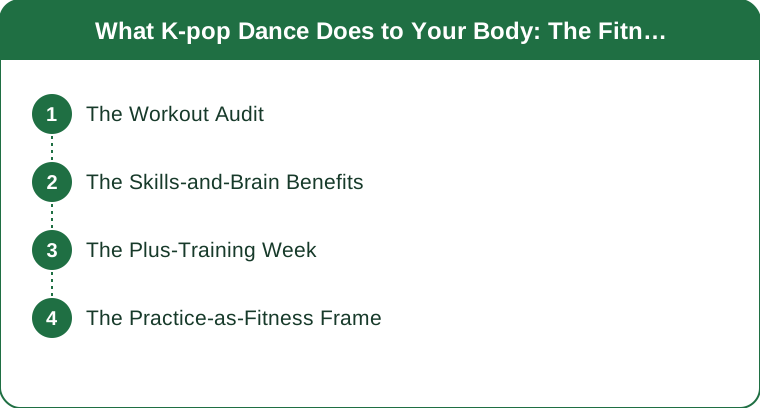
Yes, and the mechanism is closer to interval training than steady-state cardio. A full-song run-through of roughly 3-4 minutes, followed by a short rest before the next rep, mirrors the structure of a boxing round. People who wear a heart-rate monitor during practice are often surprised by how high it climbs during high-energy choreography — it’s genuinely comparable to a HIIT class, just set to a comeback track instead of a timer.
What muscles does K-pop choreography actually train?
The legs and glutes take the biggest hit, and if you’ve ever been sore the day after a practice session, you already know why. The constant half-squat bounce built into most choreography — the levels, the drops, the lunge-hits — functions as a squat-endurance session in disguise. Beyond the lower body, isolations, sharp hits, and balance moves all run on core control, which means your abs and lower back are working through nearly every eight-count even when it doesn’t feel like a “core workout.”
Are there fitness benefits beyond the physical workout?
Definitely, and this is the part most fitness tracking misses entirely. Learning and memorizing choreography is a genuine cognitive exercise, closer to a memory workout than a physical one, and the coordination it builds transfers to other movement skills. On top of that, filmed covers and performance practice double as low-stakes exposure to being watched, which a lot of dancers describe as a quiet confidence builder over time. And because the workout is something you’d do anyway for the fandom, it tends to stick — the fitness arrives as a side effect of something you already enjoy, which is exactly why it’s sustainable long term.
What should a dancer add to build a complete program?
Dance alone has real gaps, mainly upper-body pulling strength and heavy-load resistance work that choreography simply doesn’t provide. Two weekly strength sessions covering squat, hinge, push, and pull basics fill that gap and make drops and hits noticeably more effortless. Pair that with a mobility block for hips and ankles — choreography constantly asks for range you may not have yet — and a short warm-up before any full-out practice, since cold starts are a common way ankles roll during sudden level changes.
What Nobody Tells You About Treating Dance Like a Workout
- Three-plus practice sessions a week already meets general cardio guidelines — the “this isn’t real exercise” guilt most dancers carry is misplaced.
- A wearable during practice legitimizes the hobby, at least on paper, once you see the calorie and heart-rate zone data.
- Cover-team practice doubles as workout accountability — showing up for your team is a stronger habit driver than showing up for yourself alone.
- Volume spikes are real when a new comeback drops and everyone suddenly practices four hours instead of one — that’s exactly when injuries creep in.
- Rest days matter for dancers too, even though it doesn’t feel like “training” in the traditional sense.
Is K-pop dance enough exercise on its own?
For general fitness, dancing three or more times a week can meet standard cardio recommendations on its own. It’s lighter on upper-body strength and heavy resistance, though, so pairing it with two strength sessions a week rounds it into a more complete program rather than a cardio-only routine.
How do I avoid injury when practicing K-pop choreography?
Warm up before any full-out run-through, especially with cold starts or sudden increases in practice volume around new comeback releases, since that’s when ankle rolls and strains are most common. If you feel sharp pain, ongoing joint discomfort, or something that doesn’t ease up with rest, stop and see a doctor or physical therapist rather than dancing through it.
Do I need dance experience to get fitness benefits from this?
No — the dance-fitness door is open at basically every skill level, and plenty of beginner-friendly tutorials and classes exist specifically for adults starting from zero. You’ll get cardio and coordination benefits even at a slower pace; the intensity simply scales up as your skill and stamina do.
TL;DR:
- K-pop dance practice functions as interval cardio, squat-endurance, and core training in one session.
- The biggest gaps are upper-body pulling strength and heavy resistance work.
- Two weekly strength sessions plus a mobility block and warm-up round it into a complete program.
- Watch for injury risk during volume spikes around new comebacks, and see a professional for pain that doesn’t resolve with rest.
- Three-plus sessions weekly already meets general cardio guidelines, no gym membership required.
Keep Reading
This article is for general informational and styling purposes only. Fit, sizing, and product availability may vary.