Why Formation Changes Are the Hardest Part of Learning K-Pop Choreography
Quick Answer: Formation changes are hard because they require tracking your position relative to other dancers while simultaneously executing choreography — a genuinely different skill from memorizing steps, and one that needs its own separate practice, usually with floor markers or a small group.
You can nail every move solo in your bedroom and still fall apart the moment a formation change gets added. That’s not a skill gap in the choreography — it’s a different skill entirely.
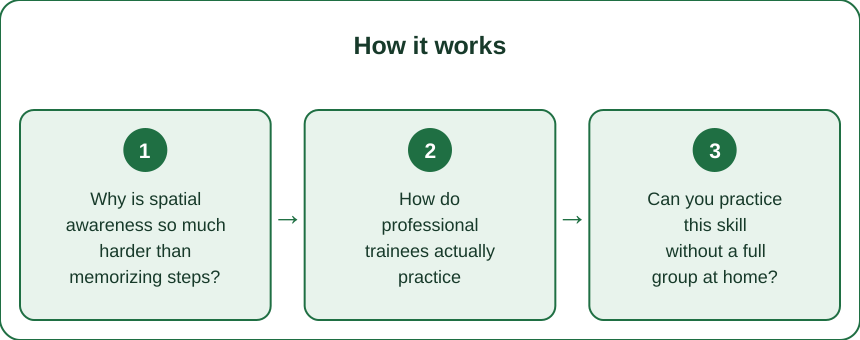
Why is spatial awareness so much harder than memorizing steps?
Learning choreography alone uses motor memory — your body learns a sequence of movements. Formation changes require simultaneous spatial tracking, monitoring where you are relative to other dancers or marks while your body is mid-movement. These are genuinely different cognitive skills, which is why being great at one doesn’t transfer automatically to the other.
How do professional trainees actually practice formation changes?
Floor spike marks (small tape marks indicating each formation position) let dancers practice transitions without needing the full group present every time. Many practice rooms mark 4-6 formation points on the floor specifically so individual practice can include spatial elements, not just step memorization.

Can you practice this skill without a full group at home?
Yes — use tape marks on your floor for 2-3 formation positions and practice moving between them on the correct counts while executing the choreography. This builds the spatial-tracking skill even solo, so group rehearsals go toward refining timing rather than learning the spacing concept from scratch.
What Nobody Tells You About Formation Practice
Most people practicing formations focus on getting to the right spot, but the harder skill is arriving on the correct count without looking down at your feet to check position. Practicing formation transitions slowly, gradually removing the need to glance down, is what actually builds performance-ready spatial awareness.
FAQ: K-Pop Dance Formation Changes, Answered
How long does it typically take to get comfortable with formation changes?
Most dancers report a noticeable improvement after several dedicated practice sessions specifically targeting formations, separate from step memorization sessions.
Is formation difficulty specific to K-pop dance, or true for all group choreography?
It’s true for any group choreography, but K-pop’s frequent, fast formation changes make it a more pronounced challenge than many other dance styles.
Should beginners worry about formations before mastering the steps?
Learn steps first without formation pressure, then layer in spatial practice once the movement itself is comfortable — trying to learn both simultaneously often slows down both skills.
TL;DR:
- Formation changes require spatial tracking, a separate skill from step memorization
- Floor spike marks let dancers practice transitions without a full group present
- Solo practice with 2-3 taped floor marks builds real spatial-tracking skill
- The harder goal is arriving on-count without looking down — practice that specifically
Being great at the steps and being great at formations are two different training goals — treat them that way.
Keep Reading
This article is for general informational and styling purposes only. Fit, sizing, and product availability may vary.