What to Actually Wear on Your Feet for K-Pop Dance Practice
Quick Answer: K-pop choreography needs a shoe that balances grip for sharp stops with enough slide for pivots and turns — a flat, non-marking sole with moderate (not maximum) traction, like many dedicated dance sneakers or low-profile trainers, works better than heavily cushioned running shoes, which grip too much and interfere with pivots.
The wrong shoe doesn’t just feel off during practice — it changes what moves are physically possible to hit cleanly.
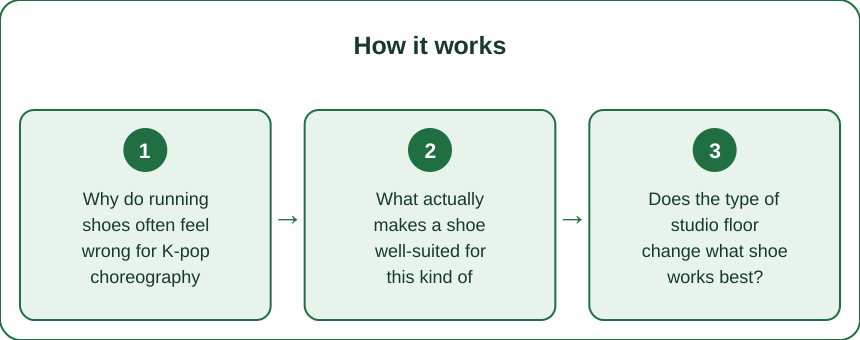
Why do running shoes often feel wrong for K-pop choreography specifically?
Running shoes are built for forward momentum and maximum grip, with deep tread patterns designed to prevent any slide at all. K-pop choreography relies heavily on pivots, spins, and quick directional changes, all of which need a controlled amount of slide — a shoe that grips too aggressively can actually catch the floor mid-pivot and stress the knee or ankle.
What actually makes a shoe well-suited for this kind of dance practice?
A flat, relatively smooth sole with moderate traction — enough grip for sharp stops and sudden accents, but enough slide for pivots and spins to happen smoothly. Many dedicated dance sneakers are built specifically around this balance, which is part of why they look similar to casual sneakers but perform differently on a studio floor.
Does the type of studio floor change what shoe works best?
Yes, significantly — hardwood or marley dance floors generally need less grip than a shoe designed for carpeted or textured flooring, since hardwood already has more natural slide built in. A shoe that works well on one floor type can feel completely wrong on another, which is why some dancers keep two different pairs for different practice spaces.
What Nobody Tells You About Dance Shoe Grip
Brand-new shoes often grip more than expected right out of the box, before the sole has broken in even slightly — many dancers notice their favorite shoe pivots differently after the first few sessions than it did on day one. Breaking in a new pair on lower-stakes practice sessions, rather than debuting them right before a performance or filming, avoids an unpleasant surprise mid-choreography.
Does ankle support matter as much as grip for this style of dance?
It matters more than most beginners expect — K-pop choreography’s quick directional changes and jumps put real lateral stress on the ankle, and a very low-profile, minimal shoe offers less stability during those moments than a slightly higher-cut sneaker. This becomes especially relevant for anyone with a history of ankle sensitivity or previous sprains.
FAQ: K-Pop Dance Shoes, Answered
Can regular casual sneakers work if dedicated dance shoes aren’t available?
A flat-soled, low-tread casual sneaker can work reasonably well as a substitute — the key is avoiding both heavily cushioned running shoes and very high-traction outdoor or basketball shoes.
Is it okay to dance in socks on a wood floor instead of shoes?
It’s common for warm-up or light practice, but full-intensity choreography in socks alone increases slip risk on most surfaces and removes the support a proper shoe provides during jumps and quick stops.
How often should dance sneakers be replaced?
Once the sole tread visibly smooths out or grip noticeably changes during pivots, it’s usually time — for regular practitioners, this often falls somewhere in the 4-8 month range depending on frequency and floor surface.
TL;DR:
- Running shoes often grip too much for pivots and spins central to K-pop choreography
- A flat sole with moderate, balanced traction suits most studio floor types best
- Hardwood versus carpeted floors can call for genuinely different shoe choices
- Ankle support matters more than expected given the style’s quick directional changes
The right shoe doesn’t just feel more comfortable — it makes pivots, stops, and sharp accents physically possible to hit the way the choreography actually intends.
Keep Reading
This article is for general informational and styling purposes only. Fit, sizing, and product availability may vary.