Why Your Choreography Falls Apart the Moment You Put the Outfit On
Quick Answer: Clothing changes three things at once — the friction between you and the floor, the weight and drag on your limbs, and the visual line the camera reads. Shoes alter your pivots most, sleeves and skirts alter your timing, and anything restrictive at the shoulder or hip silently shortens your range. Rehearse in the outfit at least three times before you film, not once.
The choreography did not change. The conditions did.
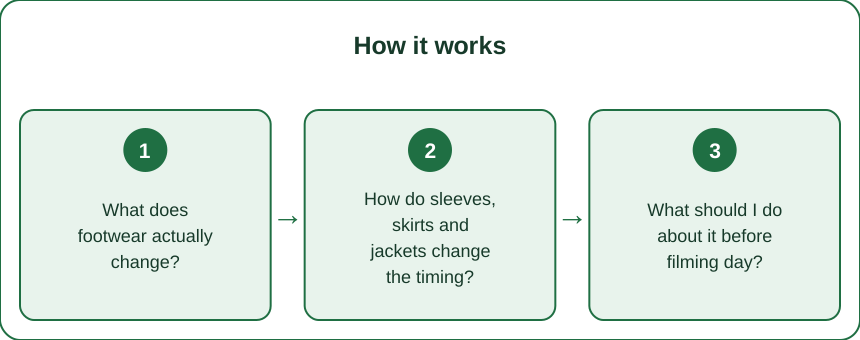
What does footwear actually change?
Friction is the single biggest variable in the whole outfit. Practice trainers grip; boots slide; socks slide differently again. Every pivot, slide and hard stop in the choreography was learned at one friction level and has to be relearned at another.
Heel height changes your centre of mass and your ankle angle. Even a two-centimetre heel shifts weight forward onto the ball of the foot, which changes how quickly you can load and unload each leg.
Sole stiffness changes how fast you can roll through the foot. A stiff sole makes footwork look blockier; a flexible one lets the foot articulate, which is a large part of what makes movement read as sharp.
Weight matters more than people expect. A boot that is 300 grams heavier per foot changes leg swing timing measurably across a three-minute routine, and it shows up as lateness in the second half rather than the first.
And ankle coverage restricts range. High boots limit ankle flexion, which limits how deep you can sit into a position, which changes the whole line of the body above it.
How do sleeves, skirts and jackets change the timing?
Anything with mass on the arm slows the arm. A long sleeve with weight, a jacket, or anything with hardware adds inertia. Arms that hit exactly on the beat in a t-shirt land fractionally late in a jacket.
Loose fabric keeps moving after you stop. Sharp choreography relies on the stop being visible. A flowing sleeve continues past the endpoint, which reads as soft even when your body was precise.
Skirts and wide legs change your sense of your own feet. You lose the visual reference of seeing your legs, and spacing frequently drifts as a result.
Restrictive shoulders are the most common problem. Fitted jackets, cropped tops with tight armholes and anything structured all reduce overhead range. You compensate without noticing, and the arms look shorter on camera.
Waistbands change your hip movement. A stiff waistband or a belt limits the isolation that a lot of choreography depends on, and this is why some outfits make hip movement look muted.
And you fidget. Adjusting a strap, pulling down a hem, or checking a sleeve mid-run costs you concentration exactly where the routine is most demanding.
What should I do about it before filming day?
Rehearse in the full outfit at least three times. Once is enough to discover the problems and not enough to solve them. Three runs is roughly where the adjustments become automatic.
Break in the shoes on the actual surface. New soles are at their most slippery, and the floor you film on is usually not the floor you practised on.
Film a test run in the outfit early, at least a week out. Seeing it on camera reveals the visual problems — sleeve drag, hem interference, restricted arms — that you cannot feel from inside.
Fix what you can with tape and stitching. Double-sided fashion tape for hems and necklines, a stitch to shorten a sleeve, and a hair tie on a loose strap solve most outfit problems for the cost of ten minutes.
Do a full run in it, not just sections. Outfit problems concentrate in the last third, when you are tired, sweaty and less patient with a strap.
And test it seated and in the transitions, not just standing. Floorwork, kneeling and quick level changes are where outfits fail most visibly.
What Nobody Tells You About Dancing in Costume
Professional dancers rehearse in costume for exactly this reason, and it is treated as a required stage rather than a nice extra. The technical dress rehearsal exists because everyone learned this the hard way.
Sweat changes the outfit mid-run. Fabric that moved freely in minute one clings by minute three, and clinging fabric restricts differently from loose fabric. A single full run tells you more than five section runs.
The camera exaggerates everything the outfit does. Fabric drag that is barely visible in person reads clearly on video, and a slightly restricted arm looks substantially shorter through a lens.
Colour affects perceived sharpness. High-contrast outfits make lines read more clearly; tonal outfits blur the edges of the body and make the same movement look softer. This is a real effect, not a preference.
Your confidence changes your movement more than the fabric does. An outfit you keep adjusting produces cautious dancing, and cautious dancing reads as under-rehearsed even when it is not.
Hair is part of the costume and nobody plans it. Hair that falls across the face in a head roll ruins a take, and finding that out on filming day is a completely avoidable loss of an hour.
And the surface is part of the outfit too. A studio floor, a gym floor and an outdoor concrete space have wildly different friction, and the shoe that was perfect indoors can be dangerous outdoors.
FAQ: Outfit and Choreography Questions, Answered
How far in advance should I choose the outfit?
At least two weeks before filming, so you have time for three rehearsals in it plus any alterations. Choosing the day before is the single most common cause of a disappointing take.
Should I practise in the shoes the whole time?
Not for every session — that wears them out and can be hard on your joints. Use them for the last few full runs before filming, and always on the floor you will film on.
What if the outfit genuinely restricts a move?
Change the outfit or change the move. Fighting a restriction for three minutes on camera always looks like fighting a restriction.
TL;DR:
- Footwear changes friction, ankle range and leg swing timing — it is the biggest single variable.
- Sleeves and jackets add inertia and keep moving after you stop, which softens sharp choreography.
- Restrictive shoulders and waistbands shorten range without you noticing.
- Rehearse in the full outfit at least three times, film a test run a week out, and do full runs not sections.
- Plan hair and the filming surface as part of the outfit.
You rehearsed the routine. Now rehearse the conditions.
Keep Reading
This article is for general informational and styling purposes only. Fit, sizing, and product availability may vary.