Why K-Pop Choreo Feels Impossible to Memorize Until It Suddenly Isn't
Quick Answer: K-pop choreography memorization often feels like a sudden click rather than gradual progress because it relies on procedural memory (motor patterns) consolidating below conscious awareness — repeated practice builds toward a threshold, and once crossed, the movement becomes automatic almost overnight rather than incrementally.
Day one through day four feel like almost no progress. Then day five, the whole eight-count sequence just comes out, fluidly, like it was always there. That jump isn’t random — it’s how a specific type of memory actually works.

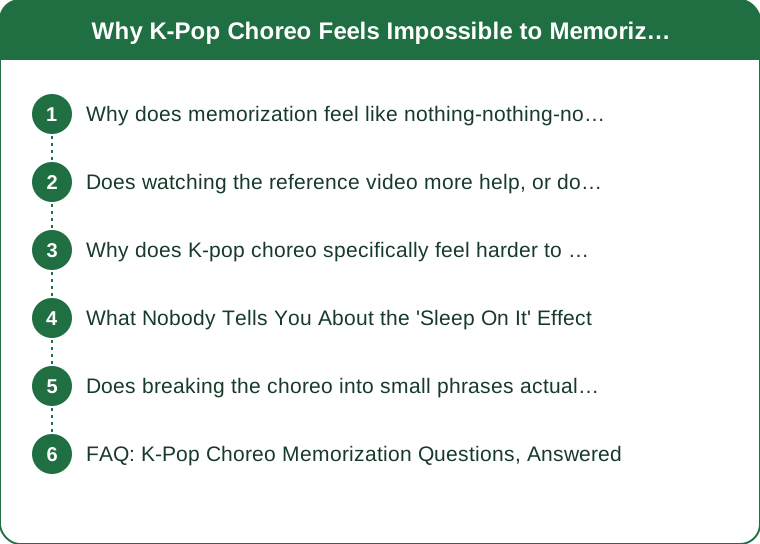
Why does memorization feel like nothing-nothing-nothing-suddenly-everything?
Choreography memorization relies heavily on procedural memory — the same memory system responsible for motor skills like riding a bike — which consolidates differently than the declarative memory used for memorizing facts or lists. Procedural memory tends to build below conscious awareness through repetition, without producing much felt sense of progress, until it crosses a consolidation threshold and becomes noticeably, sometimes suddenly, more automatic. This is a documented pattern in motor learning research, not something specific to K-pop or dance.
Does watching the reference video more help, or does it need to be physical repetition?
Both play a role, but physical repetition specifically builds the procedural, muscle-memory component that watching alone can’t fully replicate — you can be able to describe a move accurately from watching and still be unable to physically execute it fluidly, because those are genuinely different memory systems being engaged. A useful ratio for most learners: enough watching to understand the sequence conceptually, then significantly more physical repetition than feels necessary, because that’s where the actual automatic execution gets built.
Why does K-pop choreo specifically feel harder to memorize than some other dance styles?
K-pop choreography often combines unusually dense information per phrase — formation changes, facial expression cues, and precise counts within fast tempo sequences — compared to some other dance styles with more repetitive or simpler structural patterns. This higher information density per section genuinely does require more repetitions to reach the same consolidation threshold, which is a real difference in difficulty, not just a perception.

What Nobody Tells You About the ‘Sleep On It’ Effect
Sleep plays a documented, meaningful role in procedural memory consolidation — practicing a phrase, sleeping, then returning to it the next day frequently shows a genuine jump in fluency compared to the same amount of practice compressed into a single day without sleep in between. This is part of why cramming a full routine the night before a performance tends to underperform compared to the same total practice time spread across several days with sleep between sessions — the consolidation needs the sleep, not just the repetitions.
Does breaking the choreo into small phrases actually speed this up?
Yes, meaningfully — smaller phrases reach their individual consolidation threshold faster than a full-length routine attempted as one unit, and linking already-consolidated small phrases together is easier than trying to consolidate a long unbroken sequence all at once. This is the same chunking principle used in most motor-skill learning research, and it’s a large part of why breaking an 8-count into two 4-counts (a common dance-teaching technique) genuinely accelerates the process rather than just feeling like a beginner simplification.
FAQ: K-Pop Choreo Memorization Questions, Answered
How many repetitions does it typically take for choreo to feel automatic?
Highly variable by phrase complexity and individual, but the practical pattern most dancers report is a threshold effect after several sessions — not gradual, linear improvement.
Does sleeping between practice sessions actually help memorize choreo faster?
Yes — procedural memory consolidation is genuinely supported by sleep, which is part of why spreading practice across several days with sleep between sessions tends to outperform the same total time crammed into one day.
Why can I do a move correctly once but not repeat it immediately?
That single success is often the first sign the pattern is close to consolidating, not yet fully automatic — a few more focused repetitions typically closes that gap.
TL;DR:
- Choreo memorization relies on procedural memory, which consolidates below awareness until a threshold is crossed
- Physical repetition builds the automatic execution that watching alone can’t replicate
- K-pop’s dense information per phrase (formations, counts, expression) genuinely requires more reps than simpler styles
- Sleep between practice sessions meaningfully speeds up consolidation — cramming underperforms spaced practice
The sudden click isn’t luck — it’s procedural memory finishing a consolidation process that was already underway during all the sessions that felt like nothing was happening.
Keep Reading
This article is for general informational and styling purposes only. Fit, sizing, and product availability may vary.