Why Mirrored Tutorials Slow Down Your Choreography Learning
Quick Answer: Mirrored tutorials let you copy directly without mental rotation, which speeds up the first hour and slows down everything after it. You learn the movement anchored to a screen rather than to your own body, and the anchor has to be removed later. Use mirrored video to learn shapes, then switch to unmirrored and no video as soon as the sequence is roughly known.
Mirrored tutorials feel like a gift. Raise the hand the instructor raises, step the way they step, no translation required.
Then you try it without the video and something is missing. Not the moves — you know the moves. The problem is that you know them as responses to a screen.
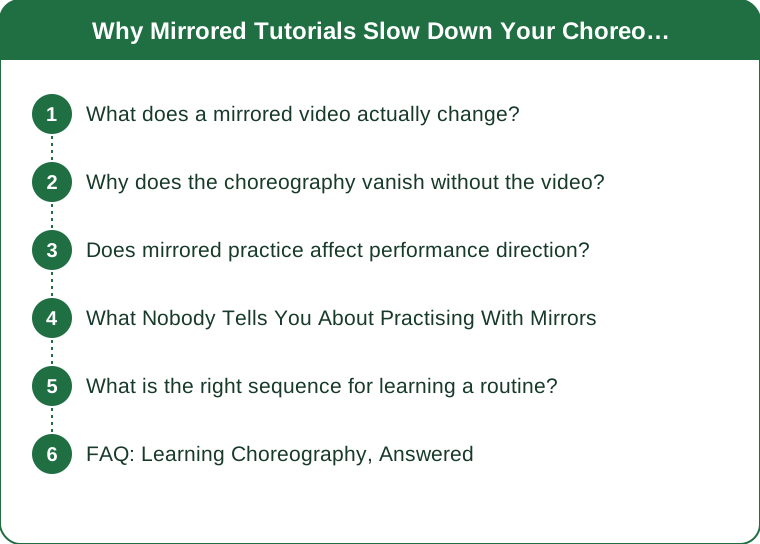
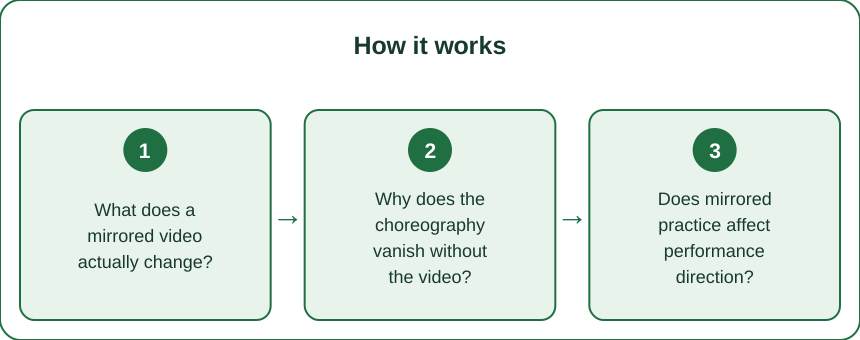
What does a mirrored video actually change?
It removes a mental rotation step, and that step was doing something.
When you watch an unmirrored video and copy it, your brain performs a spatial transformation — mapping the performer’s left to your right, converting their perspective to yours. That is genuine cognitive work, and it is why unmirrored learning feels harder.
Effort during learning is not the same as inefficiency in learning. A large body of motor learning research points the same direction: conditions that make practice harder and slower often produce better retention and better transfer. The technical term is desirable difficulty, and mirrored video removes exactly that difficulty.
There is a second, subtler cost. Copying a mirrored video encourages you to encode the movement in terms of what you see rather than what you feel. Your reference becomes external. That works perfectly while the reference is available, which is why the choreography evaporates the moment you turn the screen off.
Why does the choreography vanish without the video?
Because you learned a sequence of responses rather than a sequence of movements.
Cued recall and free recall are different capacities. If every move in your memory is attached to the visual cue that preceded it on screen, you have built a chain that only runs when someone starts it. Remove the cue and the chain has no starting point.
You can test this in thirty seconds. Stand up, no music, no screen, and mark through the first eight counts from memory. If you can do it, the choreography is genuinely yours. If you find yourself picturing the video and waiting for it to tell you, it is not yet.
The fix is to practise retrieval, not repetition. Watching the tutorial one more time feels productive and mostly is not. Attempting the section from memory, failing, and then checking is uncomfortable and builds far more durable recall — this is one of the most consistently replicated findings in learning research, and it applies to movement as directly as to facts.
Does mirrored practice affect performance direction?
Yes, and this is the practical problem that catches people out at the worst moment.
If you learn from mirrored video, you have learned the mirror image of the actual choreography. Your left is the performer’s left as seen in a mirror, which is their right in reality.
For solo practice this changes nothing. It becomes a serious problem in three situations: dancing in a group where everyone else learned it unmirrored, performing in a formation where direction matters, and any cover where you are matching official footage.
Relearning a direction after it is automatic is genuinely difficult, considerably harder than learning it correctly first. The motor pattern is established and the old direction keeps reasserting itself under pressure — which is exactly when you least want it.
If there is any chance you will dance this with other people or perform it facing an audience, learn it unmirrored from the start and accept the slower first hour.
What Nobody Tells You About Practising With Mirrors
The studio mirror creates the same dependency. Learning while watching yourself builds a loop where your correction comes from vision rather than from proprioception. Then you perform facing an audience with no mirror and your timing and spacing feel unfamiliar.
Mirror practice makes your head position wrong. Watching yourself means your eyes stay locked forward, so head movements and eye lines — a huge part of what makes choreography read as performance — never get trained.
Filming yourself is better than the mirror for correction and worse for real time. Use the mirror sparingly for checking a specific shape, and use video for reviewing a full run. Neither should be running during most of your practice.
Slow music does not always help. Some sections are timing-dependent in ways that break at reduced speed, particularly sharp accents and body waves. Learn shapes slow, learn timing at tempo.
Practising in socks changes what you learn. Slippery floors let you cheat pivots and slides that you will not get away with in shoes on a different surface. Learn in what you will perform in as soon as the moves are known.
What is the right sequence for learning a routine?
Use each tool for the phase it actually helps, and drop it promptly.
Phase 1 — shapes, roughly 20 percent of your time. Mirrored tutorial is fine here, at reduced speed, learning what the body does in eight-count chunks. Do not run the whole song. Do not worry about quality.
Phase 2 — direction and timing. Switch to unmirrored official footage now, while the pattern is still soft enough to redirect. This is the moment that decides whether you will have a direction problem in three weeks.
Phase 3 — retrieval, and this should be most of your practice. No video. Attempt from memory, get stuck, check briefly, attempt again. Uncomfortable, slow, and where the actual learning happens.
Phase 4 — performance conditions. Music only, no mirror, correct shoes, correct facing. Film a full run and review afterwards rather than during.
Most people spend 80 percent of their time in phase 1 because it feels the most productive and demands the least. Inverting that ratio is the single biggest change available to anyone who keeps forgetting choreography they thought they had learned.
FAQ: Learning Choreography, Answered
Are mirrored tutorials ever the right choice?
Yes — for a fast rough pass at complex hand or arm sections, and for anyone who genuinely struggles with spatial rotation and would otherwise give up. The rule is to leave them early rather than to avoid them entirely.
How long should I stay on one eight-count?
Until you can do it twice from memory, then move on and come back. Spaced revisiting beats grinding a single section until it is perfect, which produces sharp performance in practice and poor retention the next day.
Why can I do it perfectly alone and badly in a group?
Because group dancing adds spacing, peripheral awareness and social pressure, all of which consume attention. Practise with something occupying your attention — a conversation, a second task — and the gap narrows quickly.
Is it worth learning both directions?
For most people no; it doubles the work and increases confusion under pressure. Learn one direction properly. Reserve both-sides practice for dancers training versatility deliberately.
TL;DR:
- Mirrored tutorials remove the mental rotation that helps encode movement, so the first hour is faster and the retention is worse.
- Learning from a screen creates cued recall — the choreography works with the video and disappears without it.
- Direction learned mirrored is genuinely hard to reverse later, which matters for groups and performances.
- Spend most of your practice attempting from memory rather than watching, and switch to unmirrored footage early.
Try one session where you watch the tutorial exactly twice and spend the rest of the time failing from memory. It will feel like a worse practice and you will remember far more of it tomorrow.
Keep Reading
This article is for general informational and styling purposes only. Fit, sizing, and product availability may vary.