Why Practicing in a Small Room Quietly Rewrites Your Choreography
Quick Answer: In a small room you unconsciously shrink your travel, cut your arm extension, and shorten your preparation steps — and because motor learning is context-dependent, your body stores the shrunken version as the move. The result is choreography that reads as small and hesitant the moment you have space. Fix it by practicing sections at full size even when you cannot travel, and by marking the real spacing on the floor.
You have the whole chorus clean. Then you get into a studio with actual floor and suddenly you are half a beat behind and standing in the wrong place.
Nothing about the choreography changed. What changed is that your room was teaching you a slightly different dance the whole time.
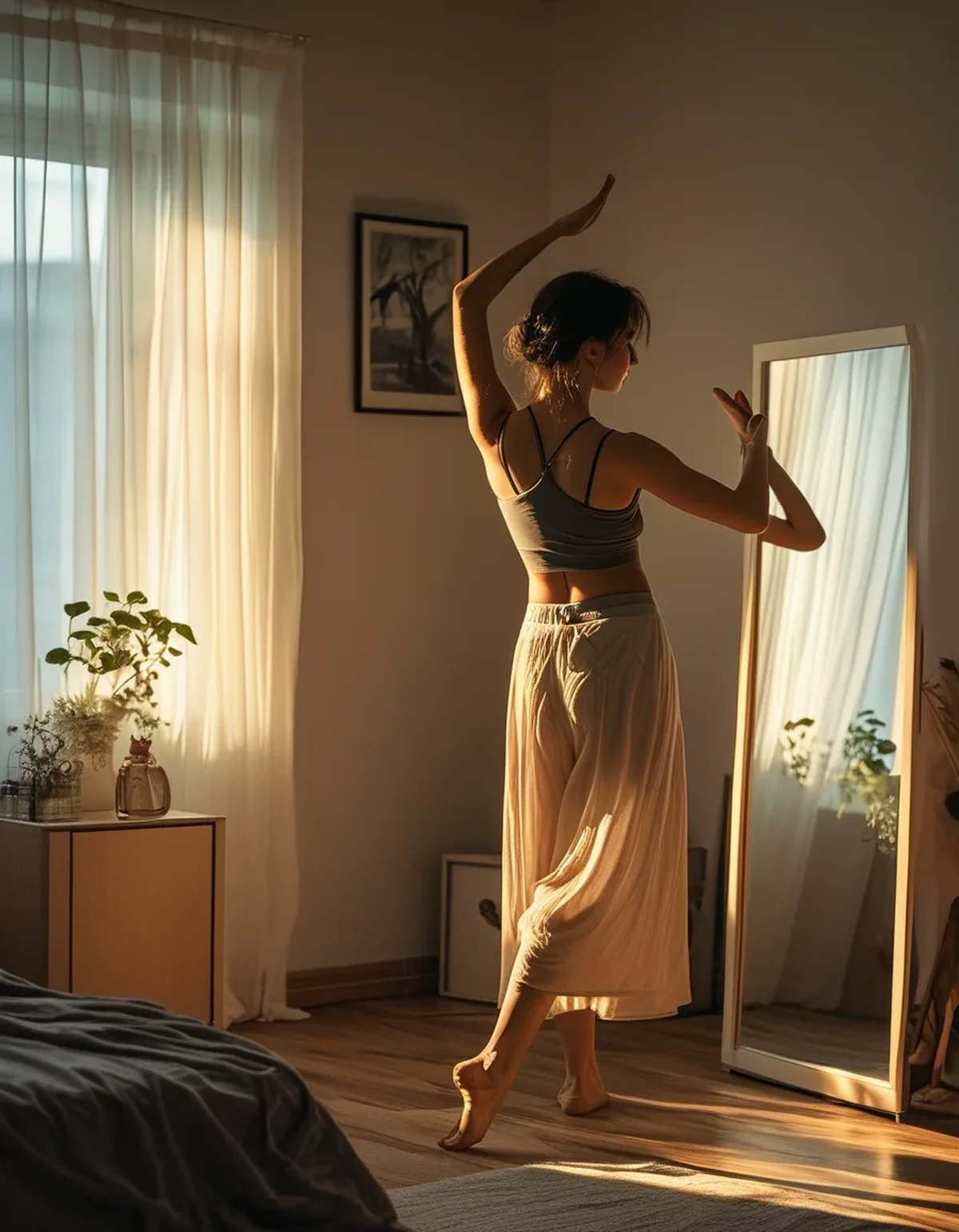
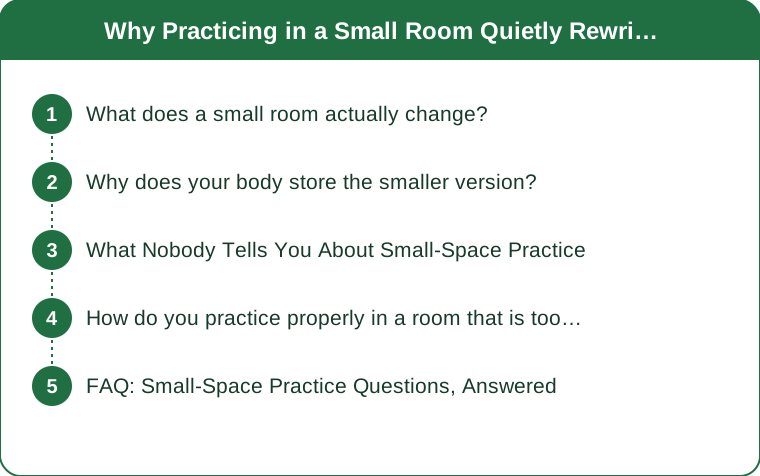
What does a small room actually change?
Four things, and none of them feel like compromises while you are making them.
Travel shrinks first. A move that should cover three steps becomes one and a half, because there is a bed there. Your body still hits the count — it just covers less ground. Do that fifty times and the reduced version becomes the version you know.
Arms retract. Full extension in a small room means hitting a wall, a lamp, or a doorframe. You learn a slightly bent, slightly early arm. This is the most visible one on camera, because K-pop choreography lives on sharp full extensions and half-extended arms read as unconfident regardless of timing.
Preparation steps disappear. The small setup step before a big movement is the first casualty of limited space, and it is the thing that makes the big movement look powerful. Without it, the move arrives from nowhere and looks weak.
Levels flatten. Deep lunges, floor work, and low drops need clearance you do not have. People quietly raise everything an inch or two.
The uncomfortable part is that all of these feel like the real move while you are doing it. There is no moment where you decide to make it smaller.
Why does your body store the smaller version?
Because motor learning is contextual. You are not just learning a movement, you are learning a movement in an environment.
Spatial references get encoded with the movement. Your brain uses the room to calibrate — the mirror is here, the wall is there, the turn ends facing the door. When the room changes, those references vanish and part of the routine goes with them. This is the same reason choreography you know perfectly falls apart the first time you perform it facing an audience instead of a mirror.
Repetition writes amplitude, not just sequence. Practice does not only encode which move comes next. It encodes how big, how fast, how far. Fifty reps of a 60 percent size move is fifty reps of a 60 percent size move, no matter what your intention was.
Timing gets recalibrated to the shorter distance. If your travel is half as long, you arrive early. Your body adjusts by adding a small pause or slowing the approach — and now the timing itself is wrong in a big space, not just the size.
This is why the studio experience is so disorienting. It is not that you forgot. It is that you are being asked to perform a version you never actually practiced.
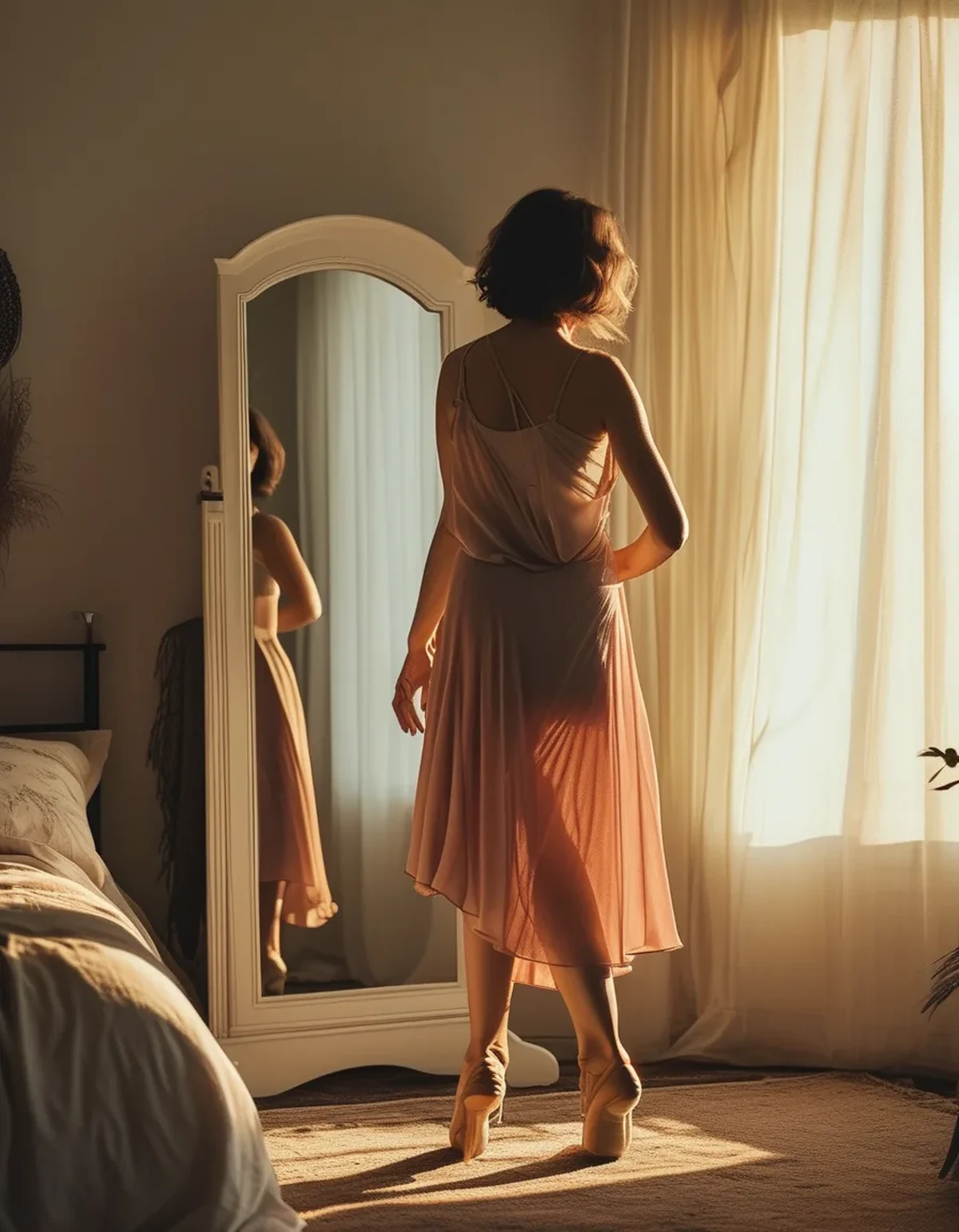
What Nobody Tells You About Small-Space Practice
Full-size arms cost nothing but attention. You almost always have vertical and lateral space even in a tiny room, even if you have no travel. Committing to complete extension on every rep is the highest-value habit available, and it fixes the most visible problem.
Marking is a skill, not a compromise. Professional dancers mark constantly. The difference is that they mark deliberately — reduced energy, full spatial intent — rather than shrinking unconsciously. Marking with correct spacing in your head is training. Shrinking without noticing is un-training.
Tape on the floor changes everything. Two strips of painters tape marking where you should start and end a traveling section gives you the spatial feedback the room is not providing. When you cannot reach the second mark, you know immediately.
Practice the section in place, then the travel separately. Do the upper body at full size standing still, then walk the floor pattern with no arms in a hallway or outside. Your brain reassembles them faster than you would expect.
Record from further away than feels necessary. A phone two feet from you flattens everything and hides exactly the shrinkage you are trying to catch. Back it up to the far corner even if you have to cut off your feet.
How do you practice properly in a room that is too small?
A workable structure for a bedroom-sized space.
Split the routine into stationary and traveling sections. Be explicit about which is which. Stationary sections can be practiced at 100 percent in almost any room, so those get full-commitment reps.
For traveling sections, practice the count and the intent, not the distance. Do the move with full arm and body size while stepping in place, and count the travel out loud. Your body keeps the amplitude; you consciously carry the spatial information.
Use tape or objects to mark real distances wherever you can, even in a hallway. Ten minutes in a hallway with correct spacing beats an hour in a bedroom without it.
Rotate your practice orientation. Do not always face the same wall. Practicing facing three different directions reduces how much your body relies on room landmarks, which is the thing that fails you on stage.
Book real space before you film. One studio hour before a cover shoot is worth more than another week in your room. Go in with the choreography learned and use the hour for spacing and size, which are the two things you could not practice.
Warm up properly regardless. Small spaces encourage skipping the warm-up because there is nowhere to move. Full-size choreography on a cold body in a cramped room is how ankles and knees get hurt.
FAQ: Small-Space Practice Questions, Answered
Is practicing in a small room worse than not practicing?
No — repetition still builds sequence memory, coordination, and musicality, and those transfer fine. The specific things that do not transfer are size, travel, and spacing. Practice in your room, and be deliberate about fixing those three things when you get space.
How much studio time do I actually need?
For a typical cover, an hour before filming is usually enough if you already know the choreography cold. The studio time is for spacing and full-size runs, not learning. Trying to learn in expensive rented space is the most common way people waste it.
Why does it feel harder in a big room, not easier?
Because you are finally doing the full-size version, which takes more energy, more range, and more travel than what you trained. Feeling more tired in a studio is a sign of how much your room was shrinking things — it is diagnostic information, not a fitness problem.
TL;DR:
- Small rooms shrink travel, arm extension, preparation steps, and levels — all without you deciding to
- Motor learning stores amplitude and spatial references, so the shrunken version becomes the version you know
- Commit to full-size arms always, mark real distances with tape, and rotate which wall you face
- Book one hour of real space before filming and spend it on spacing and full runs, not on learning
Your bedroom is a perfectly good place to learn choreography. It is just a terrible place to find out how big the choreography is supposed to be.
Keep Reading
This article is for general informational and styling purposes only. Fit, sizing, and product availability may vary.