Why Recording Yourself Fixes Choreography Faster Than the Mirror
Quick Answer: Watching a mirror splits your attention between performing and evaluating, which degrades both, and it can only show you the exact instant you happen to look. Video removes the evaluating task from the performance and lets you review timing, transitions, and body lines you physically cannot see live. Two or three takes with review between them beats an hour of mirror repetition for fixing specific problems.
The mirror is a rehearsal tool. The camera is a diagnostic one.
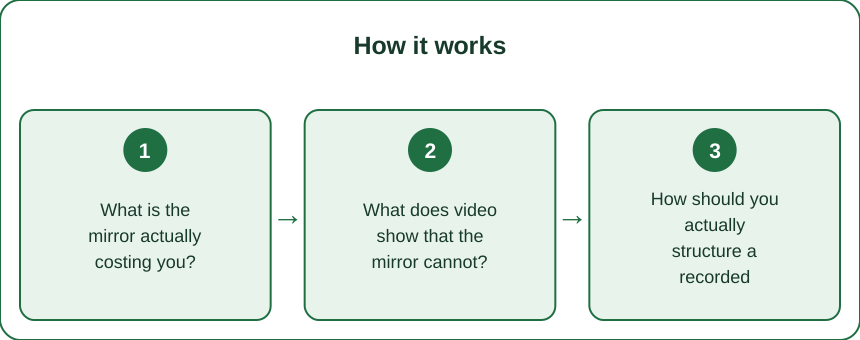
What is the mirror actually costing you?
Attention, mostly, and in a way that is hard to notice while it is happening.
When you dance facing a mirror you are doing two jobs at once - producing the movement and evaluating it - and both degrade. The evaluation task pulls attention outward at exactly the moments that need internal focus, which is why a section can feel clean in the mirror and look wrong on video.
There is a physical cost too. Watching a mirror requires holding your head and eyes toward it, which means:
- Head position is wrong. Most choreography has specific head direction, and you cannot do it while looking at your reflection.
- Spotting for turns breaks down. You cannot spot properly and check yourself simultaneously.
- Facing is compromised. Anything that turns you away from the mirror is unmonitored, so you have blind sections you never review.
And there is a sampling problem. The mirror shows you a single instant - whichever one you happened to look at. Transitions, which is where most choreography actually falls apart, happen in the moments between your glances. You watch the pose, you miss how you got there.
The mirror is genuinely useful for learning shapes and checking a static position. It is poorly suited to diagnosing timing, flow, and transitions, which is most of what makes K-pop choreography look right or wrong.
What does video show that the mirror cannot?
Five things, and the first two are what people are usually missing.
Timing against the actual music. On video you can watch whether your hit lands on the beat, before it, or after it. In the mirror you feel like you are on time because your internal sense of the beat and your movement are generated by the same brain. Video is an external referee. Being consistently an eighth-count late is extremely common and nearly invisible from the inside.
Transitions. The connective movement between positions is where amateur choreography reads as choppy, and it is precisely what mirror glances skip. Watching a recording at half speed exposes every transition.
Your back and profile. Roughly half of most choreography faces away from front. You have never seen that half of your own dancing without a camera.
Body line in motion. Arms that feel fully extended usually are not. Shoulders that feel down are usually up. These are proprioceptive errors, meaning your internal sense is simply wrong, and no amount of trying harder corrects them - you need external evidence.
Energy and facial expression. What feels like a big performance often reads as small on camera, and this is one of the most reliable surprises for people recording themselves the first time. Since most K-pop content is consumed as video, the camera’s version is the one that matters.
One more advantage that gets forgotten: video is a record. You can compare this week to three weeks ago and see progress that daily practice completely hides.
How should you actually structure a recorded practice?
The mistake is recording everything and reviewing nothing. Structure it.
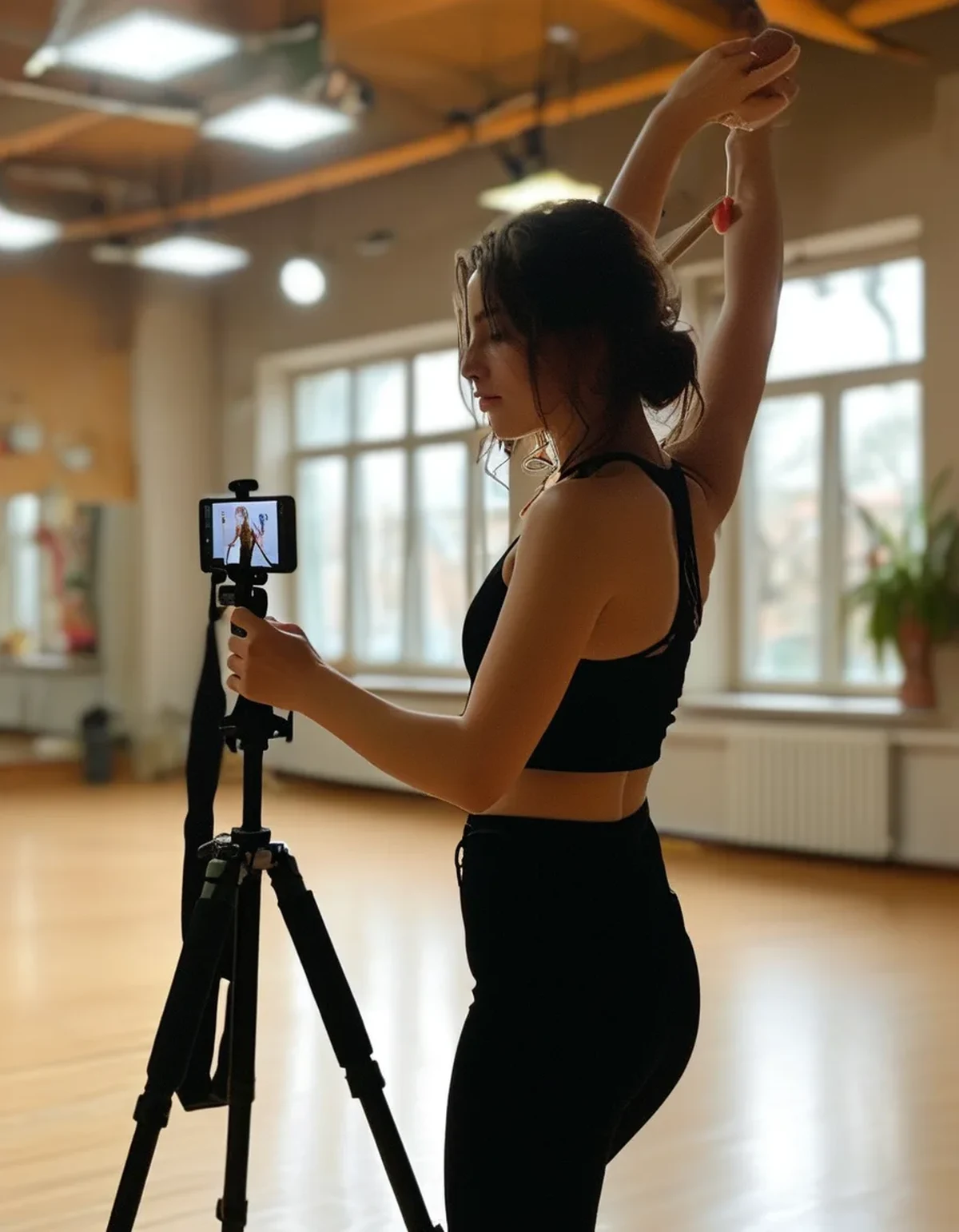
Setup: phone at chest height, far enough back that your whole body stays in frame with room above your head and below your feet, camera facing you directly rather than at an angle. Turn off the mirror function if your phone flips the image - a mirrored recording reintroduces exactly the confusion you are trying to escape.
A working session format:
- Warm up and review the choreography - 10 minutes, mirror is fine here
- Take 1: full run, no stopping - record it, do not watch yet
- Review take 1 twice - once at full speed for overall impression, once at half speed for a specific problem
- Pick exactly one thing to fix - not five. One.
- Drill that section - 5 minutes, mirror or no mirror
- Take 2: full run - record, review, pick one thing
- Take 3 - same
- Save the best take with the date
That is about 40 minutes and it produces more improvement than two hours of running the song repeatedly.
Review technique matters as much as recording. Watch each take at least twice with a different focus each time - once watching only your feet, once only your arms, once only timing. Watching everything at once means noticing nothing specific. Half speed playback is where the real information is; most phone players and video apps support it.
Compare against the reference from the same angle. Playing the official practice video beside your take, both at half speed, makes differences obvious that description never captures.
What Nobody Tells You About Watching Yourself Dance
The first few times are genuinely unpleasant. Nearly everyone dislikes their first recordings, and a lot of people quit at this stage. What you are seeing is not that you are bad - it is the gap between your internal experience and the external result, and that gap is largest for beginners and never fully closes. Push through three sessions and it stops stinging.
You will overcorrect the first thing you notice. People spot one problem, fix it aggressively, and create a new one. This is why the one-thing-per-take rule exists. Small corrections, verified on the next take.
Your phone camera lens distorts, especially up close. Wide-angle lenses stretch whatever is nearest to them, so filming too close makes limbs look wrong in ways that are the lens, not you. Stand further back and let the frame be wider.
Recording changes how you dance. Most people perform harder on camera, which is useful, but it also means your recorded version may not represent your typical practice quality. Record often enough that it stops being an event.
Audio sync on phones is not always perfect. If your timing looks off by a hair on video but feels right, check the sync before rebuilding your counts - play a clip where you clap on a beat and see whether sound and image line up.
Do not delete the bad takes immediately. A recording from four weeks ago that felt terrible at the time is the clearest evidence of progress you will ever have, and progress is what keeps people practising.
FAQ: Recording Dance Practice Questions, Answered
Should I stop using the mirror completely?
No. The mirror is good for learning new shapes, checking static positions, and drilling a specific angle. Use it while learning and use video while running. Many practice rooms have both for a reason.
How often should I record?
Every practice session for a choreography you are actively working on, even just one take. It takes 30 seconds to set up and it is the only objective feedback you have.
What if I only have a phone and a small room?
Work with it. Chest height, back as far as the room allows, and film in landscape if the room is wider than it is deep. Partial frame is better than no recording, though full body is the goal.
Is watching at half speed actually necessary?
It is where most of the useful information lives. Full speed shows you overall impression; half speed shows you which count you are late on and where a transition collapses. Do both.
How do I stop hating how I look on camera?
Give it three sessions and watch with a specific job each time - only feet, only timing - rather than watching yourself as a whole. Task-focused watching is much less uncomfortable than general self-evaluation, and it is more useful anyway.
TL;DR:
- The mirror splits attention between performing and evaluating, and it only shows the instant you happen to look.
- Video exposes timing, transitions, your back and profile, and true body line - none of which the mirror can show.
- Structure it: full take, review twice, fix exactly one thing, take again. Three takes beats an hour of repetition.
- Turn off mirroring on your phone, film from chest height with the whole body in frame, and review at half speed.
- The first few viewings are uncomfortable for everyone. It passes by the third session.
Use the mirror to learn the shapes. Use the camera to find out what you are actually doing.
Keep Reading
This article is for general informational and styling purposes only. Fit, sizing, and product availability may vary.