Why Practising at 0.5x Speed Can Actually Slow Your Learning Down
Quick Answer: Slow practice works brilliantly for learning where your body goes and poorly for learning how it gets there. Many K-pop movements rely on momentum, rebound, and elastic recoil - a whip of the arm, a body roll, a sharp hit that resets. At half speed those movements have to be produced by muscle instead of by momentum, which is a genuinely different motor pattern. You end up practising a movement that does not exist at full tempo, and then wondering why speeding up feels like starting over.
The rule of thumb: slow down to learn the map, speed up to learn the movement. Here is how to tell which parts need which.
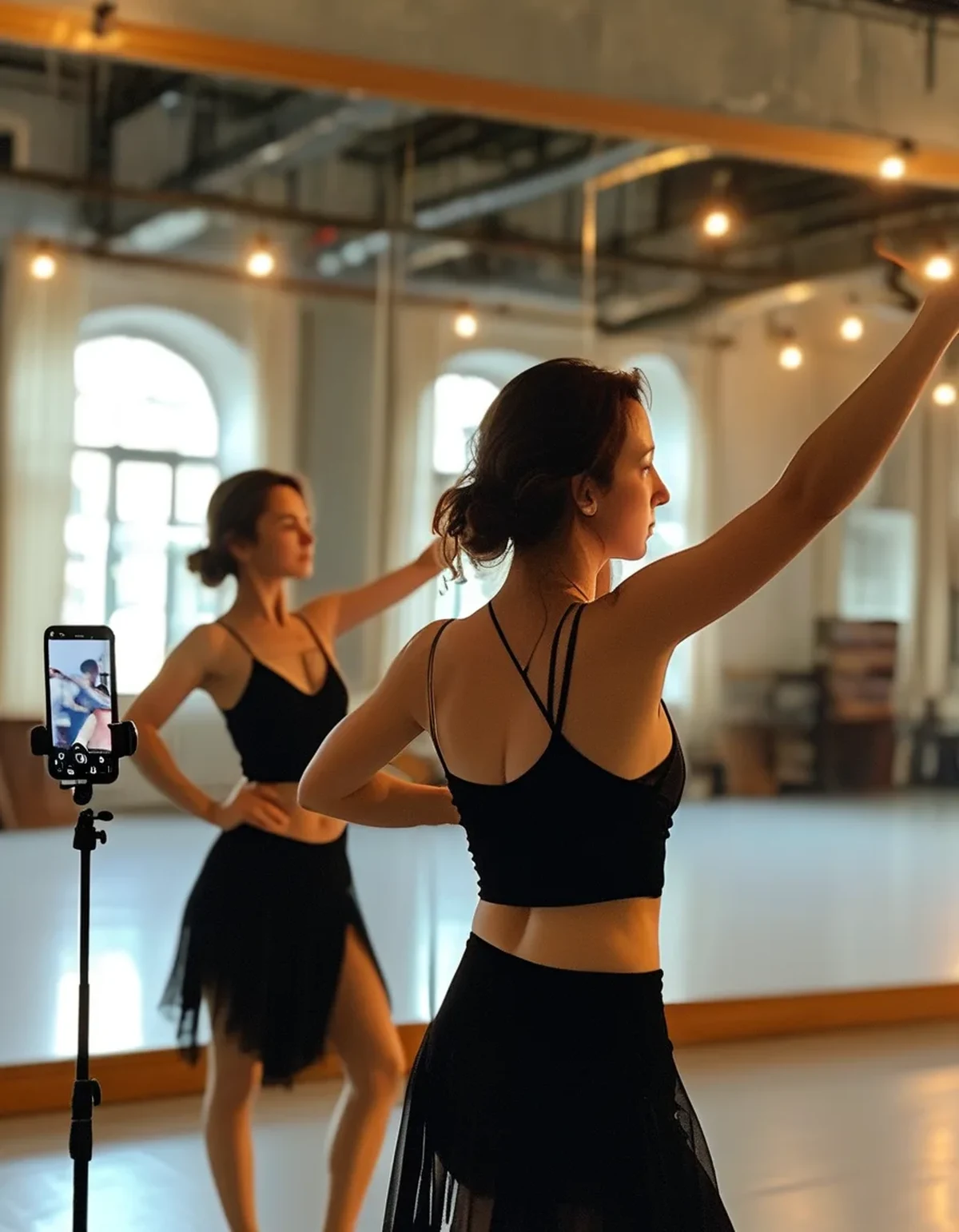
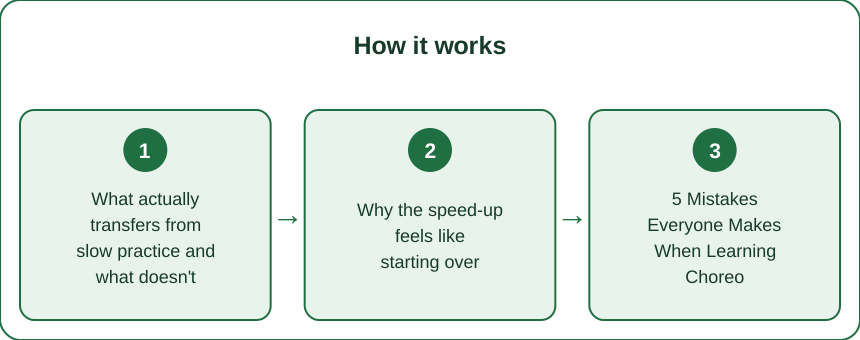
What actually transfers from slow practice and what doesn’t
Motor learning research draws a line here that dancers feel intuitively but rarely articulate.
What slow practice teaches well:
- Spatial information - where the hand finishes, which direction the body faces, where the feet land
- Sequence - what comes after what, which is genuinely the hardest part of learning choreography
- Isolated shapes - a specific arm position or hand detail you can hold still and inspect
What slow practice teaches badly:
- Anything driven by momentum. A body roll at full speed is a wave travelling through the spine. At half speed it becomes a sequence of deliberate segmental contractions, which uses different muscles in a different order
- Rebound and recoil. Sharp hits get their crispness from stopping a moving limb, not from moving a still one. There is nothing to stop at 0.5x
- Weight transfers and drops. Gravity does not slow down with the video. A drop that takes 0.3 seconds at tempo cannot take 0.6 seconds without being muscularly controlled, which is the opposite of what it should be
- Timing feel - the swing, the lag behind the beat, the anticipation. All of it lives in the tempo
The transfer problem in one sentence: you are building a motor pattern at a speed that is not the performance speed, and motor patterns are more speed-specific than people expect. The slower version does not automatically scale up.
Why the speed-up feels like starting over
Because in some respects it is, and understanding why removes a lot of frustration.
Different speeds recruit differently. Fast, ballistic movement uses a pre-programmed burst - your nervous system plans the whole action before it starts and does not correct mid-flight. Slow movement is continuously corrected by feedback as you go. These are two distinct control strategies, and practising one does not fully train the other.
Momentum does work you have to replace. At tempo, the arm swinging down carries into the next position. At half speed your shoulder has to actively produce that path, which is why slow practice of fast choreography is often more tiring than the real thing.
Anticipation disappears. Good dancers are already moving toward the next position before the current one finishes. Slow practice removes the time pressure that forces this, so you learn a stop-start version and then have to unlearn it.
And you learn the wrong stopping points. Slow practice invites you to check yourself at each position. At tempo there are no checkpoints, and the habit of glancing at the mirror at each shape becomes a stutter you can see in the final result.
None of this makes slow practice useless. It makes it a specific tool with a specific job, which is the map rather than the movement.
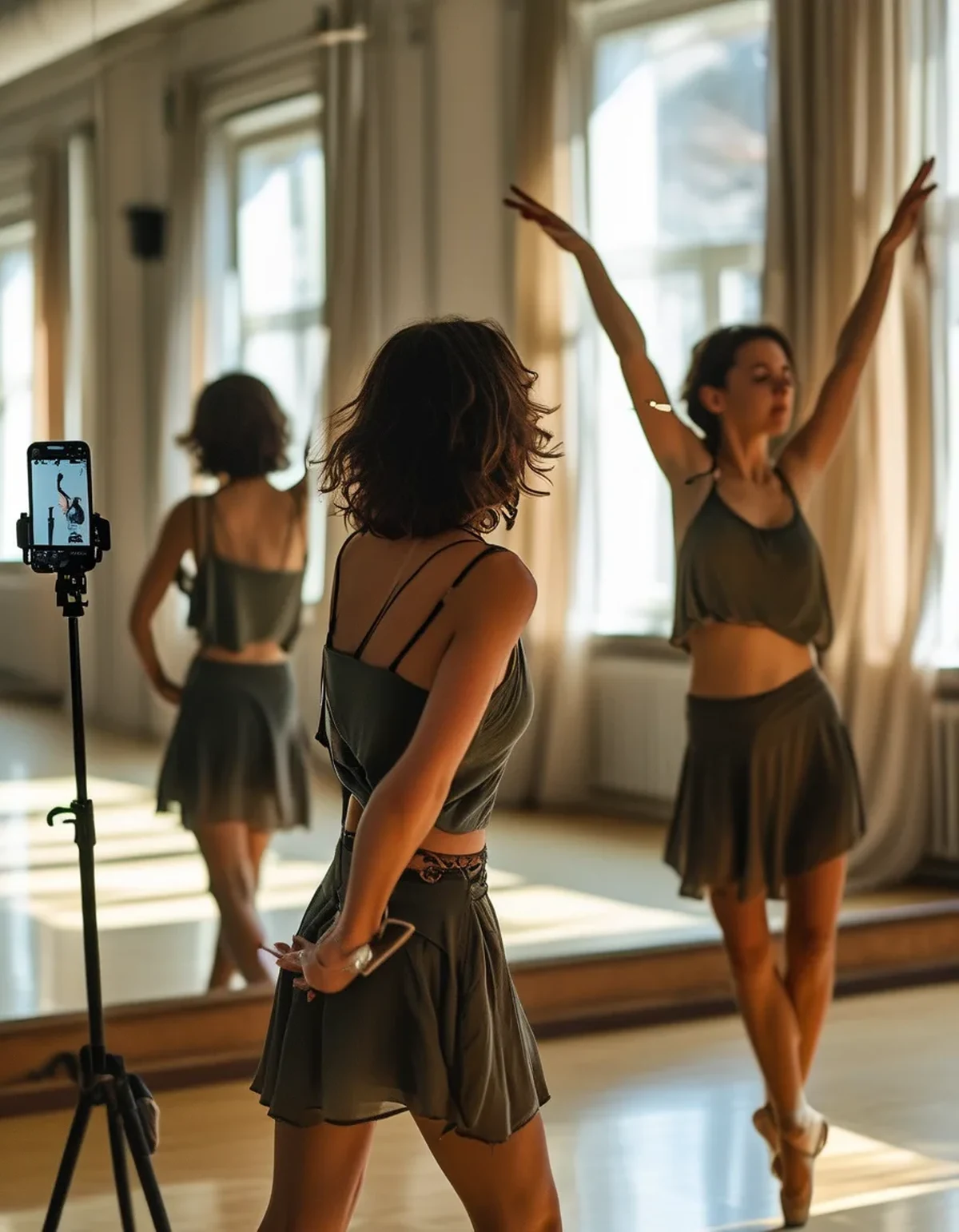
5 Mistakes Everyone Makes When Learning Choreo
1. Living at 0.5x for days. The most common error by a distance. Learn the sequence slowly for one or two sessions, then get to 0.75x quickly and to full speed the same week. The longer you stay slow, the more you have to undo.
2. Never practising above tempo. Running a section at 1.25x makes full speed feel spacious. It also exposes exactly which transitions you were only just getting away with. Ten seconds of over-tempo practice is worth a great deal.
3. Practising only in the mirror. The mirror is a feedback tool and a crutch. Choreography learned entirely facing a mirror falls apart on camera or on stage because you have outsourced your body awareness to your eyes. Alternate: mirror to check, then away from mirror to own it.
4. Learning the whole song before drilling any of it. Eight-counts are the unit that actually sticks. People run the full song repeatedly, which means practising the easy parts constantly and the hard four seconds hardly at all.
5. Skipping the transitions. People drill the recognisable moves and treat the connecting steps as filler. Transitions are where choreography looks amateur or professional, and they are the part that breaks first under fatigue or nerves.
The second one surprises most people - practising faster than the song feels reckless and is one of the most efficient things you can do.
A practice structure that actually works
Roughly 40 minutes on a single section, and it is worth more than two hours of running the song.
Phase 1 - Map, 10 minutes at 0.5x. Learn where the body goes, nothing else. Feet, facing, arm endpoints. Do not attempt texture or sharpness. Accept that it looks nothing like the original - it is not supposed to yet.
Phase 2 - Assemble, 10 minutes at 0.75x. Chain the eight-counts together and find the transitions. This is where you discover which moves you actually memorised and which ones you were reading off the screen.
Phase 3 - Tempo, 15 minutes at full speed. This is where the real learning happens and where most people spend the least time. Expect it to be messy for the first several runs. Do not retreat to slow speed when it gets ugly - the ugliness is the learning.
Phase 4 - Over-tempo and blind, 5 minutes. Two or three runs at 1.25x, then two runs at full speed facing away from the mirror. If it survives both, it is learned.
Between sessions:
- Sleep matters more than extra repetitions. Motor consolidation happens overnight, and a section practised for 30 minutes and slept on beats 60 minutes crammed in one sitting
- Film yourself at full speed, once per session. Watching it back catches things the mirror never showed you
- Return to the hardest four seconds first next session, while you are fresh, rather than warming up on the parts you already own
Where slow practice genuinely stays valuable: a specific hand detail, an unfamiliar footwork pattern, or any moment where you honestly do not know what the body is doing. Diagnose first, then choose the speed - that is the whole skill.
FAQ: Practice Speed Questions, Answered
Is 0.75x better than 0.5x as a default?
For most K-pop choreography, yes. It is slow enough to see detail and fast enough to preserve most of the momentum, which makes the transfer to full speed far less jarring.
What about mirrored versions - should I use those?
Use them to learn and then run the unmirrored original to check yourself. Learning entirely from a mirrored video means you have learned the choreography in one orientation only, which becomes a problem the moment you dance with anyone else.
I can do it at full speed alone but not with music. Why?
That is usually a timing-anchor problem rather than a movement problem - you learned the movement sequence without attaching it to specific sounds. Pick one distinct sound per eight-count and deliberately attach a move to it.
How many times should I run a section before moving on?
Until you can do it twice in a row cleanly at full speed without the mirror. Counting repetitions encourages mindless volume, while a clean-twice standard forces attention.
TL;DR:
- Slow practice teaches where the body goes; it does not teach momentum, rebound, or timing feel
- Fast and slow movement use different motor control strategies, so the slow version does not scale up
- Spend one or two sessions at 0.5x, move to 0.75x fast, and get to full tempo the same week
- Practise short bursts above tempo, and run sections away from the mirror to test ownership
- Drill eight-counts and transitions rather than running the whole song repeatedly
Next session, cut your slow practice in half and spend that time at full speed instead. It will look worse for two days and better by the end of the week.
Keep Reading
This article is for general informational and styling purposes only. Fit, sizing, and product availability may vary.