Why You Blank on Choreography the Moment the Mirror Is Gone
Quick Answer: Blanking without the mirror means you learned the choreography visually rather than physically - your eyes were steering every move, checking the reflection instead of trusting the body. Turn the mirror away and the guidance system disappears, taking the choreography with it. The fix is deliberately weaning off visual feedback: learn facing the mirror, then repeat facing away, with eyes closed, and at quarter speed until the moves live in muscle memory rather than in the reflection. Dancers who practice mirror-off from day one perform confidently anywhere; mirror-only dancers own exactly one wall of one room.
In the studio you were basically in the music video. At your cousin’s party, facing actual humans, your arms suddenly had no idea what a chorus was.

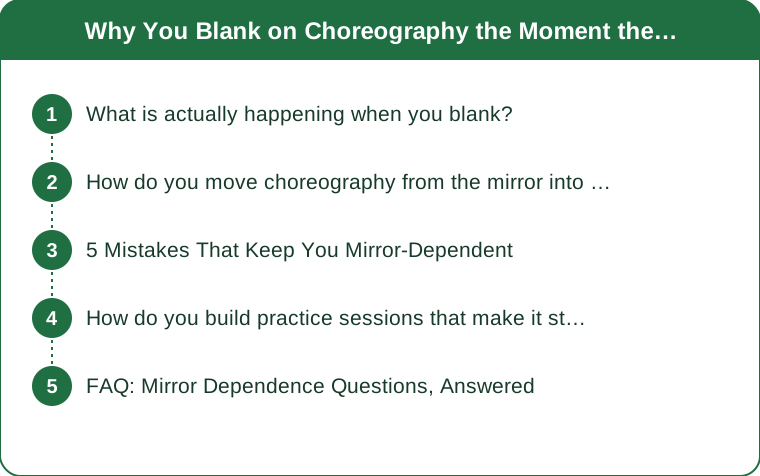
What is actually happening when you blank?
The freeze is not stage fright and not bad memory. It is a feedback loop losing its input.
Mirror learning outsources the map to your eyes. When every run happens facing the mirror, your brain learns the routine as a visual monitoring task - see the reflection, compare, correct. The reflection becomes part of the choreography.
The body was never driving. Real movement memory - the felt sense of where your limbs are without looking - only develops when it has to. With a mirror always available, that system stays a passenger, letting the eyes steer.
Remove the mirror and the loop opens. No reflection means no comparison signal, and the visual system that was steering suddenly has nothing. The blank you feel is the handoff failing: eyes asking the body to take over a job it was never given.
Orientation shifts break it further. Mirror learning also welds the routine to one facing. Turn 90 degrees, or face an audience where the mirror was, and left-right becomes actively confusing - the classic reason a routine dies at exactly the moment someone says show us.
K-pop choreography makes it worse than most. Formation changes, facing changes, and fast directional detail mean the mirror-welded version breaks at every rotation. Idol practice rooms have mirrors, but idols rehearse mirror-off and blocked to camera relentlessly - the mirror is their checking tool, not their storage.
The good news is the diagnosis is the cure. Blanking without the mirror simply tells you which stage of learning you stopped at. There is a next stage, and it is trainable in weeks.
How do you move choreography from the mirror into your body?
The method is progressive removal of visual feedback - a wean, not a cold turkey.
Stage 1: learn facing the mirror, as normal. The mirror is genuinely the best tool for acquiring shapes, angles, and timing. Use it fully for the first learning pass. The mistake is never leaving this stage.
Stage 2: same section, back to the mirror. Immediately after a section feels solid, turn around and run it three times facing the blank wall. It will feel ten times worse. That discomfort is the actual learning - the body being forced to drive.
Stage 3: eyes closed, quarter speed. Slow the section down absurdly and run it with eyes shut, feeling each position - where the weight is, what the elbow angle is, where the head turns. Slow eyes-closed reps build the internal map faster than a hundred full-speed mirror runs.
Stage 4: rotate the room. Run the section facing each of the four walls. The routine detaches from geography and left-right confusion gets solved in practice instead of in front of people.
Stage 5: film instead of mirror. Record a run, then watch. You still get correction - better correction, honestly - but it arrives after the movement instead of during it, so the body performs unassisted and the eyes critique later. This is exactly how professional teams work.
The ratio to aim for: for every three mirror runs, one mirror-off run in the same session. From the first day of a new song, not after it is finished. Retrofitting body memory onto a mirror-welded routine takes twice as long as building it in.

5 Mistakes That Keep You Mirror-Dependent
Mistake 1: Saving mirror-off for when the routine is perfect. Perfect in the mirror means welded to the mirror. The turn-around reps belong in the first session, while the movement is still forming - that is when the body can still claim the job.
Mistake 2: Only ever running the full song. Full runs hide which eight-counts are actually weak, because momentum carries you. Blank spots live in specific counts; find them by running sections mirror-off and noticing exactly where the body hesitates.
Mistake 3: Marking with your eyes glued to the tutorial. Following along with a video forever is mirror dependence with extra steps - now the dancer on screen is steering. Watch, learn, then close the laptop and run it from nothing, even badly. Retrieval is the rep that counts.
Mistake 4: Practicing only in the one room where it works. The routine gets anchored to that floor, that wall, that echo. Kitchen runs, garage runs, park runs - every new location weakens the anchor and strengthens the version you carry with you.
Mistake 5: Stopping every time you slip. In the mirror you can stop and fix; in front of people you have to keep going. Practice the keep-going skill deliberately: when you blank mid-run, groove in place through the count and catch the next phrase you know. Recovering is a skill with its own reps, and it is the one that saves performances.
How do you build practice sessions that make it stick?
A structure that produces performance-proof choreography in a few weeks of normal practice time.
Open with a no-mirror recall run. Before any review, cold-run yesterday’s material facing away from the mirror. Cold retrieval at the start of practice is the strongest memory rep of the day - it shows you honestly what stuck.
Learn new material in eight-count chunks, sealed mirror-off. Acquire the chunk with the mirror, then seal it with three away-facing reps before moving on. Sealed chunks connect into sections that survive pressure.
End with a performance run. Last run of the day: full-out, no mirror, no stopping, ideally filmed. One pressure-shaped rep per session builds the exact skill the party, the showcase, and the workshop demand.
Dress so feedback comes from feeling, not looking. This is quietly important: when you cannot see yourself, you navigate by how movement feels, and clothes are part of that signal. Fitted layers - a tank that stays put, buttery-soft leggings that move like skin - let you feel your lines without visual checks, where a baggy tee mutes the information. Plenty of dancers find their mirror-off runs improve just from switching to gear they can feel their shapes in.
Use audio-only runs. Music on, screen off, lights low. Removing everything visual - not just the mirror - forces full internal navigation, and it is strangely fun; this is where the routine starts feeling like dancing instead of copying.
Track blanks in a note. Every spot where the body hesitated, listed by count. Next session opens by drilling exactly those counts mirror-off. Blanks are not failures; they are the practice plan writing itself.
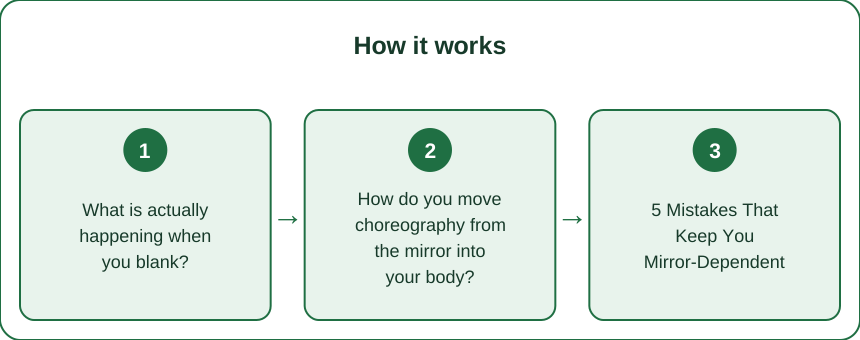
FAQ: Mirror Dependence Questions, Answered
Why can I dance in the studio but not anywhere else?
Because the choreography was learned as a visual task - your eyes steering via the reflection - and welded to one room and one facing. Without the mirror, the body has to drive a routine it never practiced driving. Mirror-off reps fix it faster than more mirror reps.
How long does it take to stop being mirror-dependent?
With the wean built into normal practice - three mirror runs to one mirror-off, eyes-closed slow reps, weekly filmed runs - most dancers feel the shift within two to four weeks per routine, and new routines learned this way never develop the dependence.
Should I practice with my eyes closed?
Yes, at drastically reduced speed. Slow eyes-closed reps build the internal sense of position that mirrors suppress. Keep them to short sections at quarter speed with clear space around you.
Is learning from mirrored tutorial videos making this worse?
Mirrored tutorials are fine for acquisition - they solve the left-right translation problem. The dependence comes from never running the material without a visual guide, so close the video and cold-run every section you learn.
What do I do when I blank mid-performance?
Keep moving through the count - groove in place, hit the next phrase you know, and let the music carry you back in. Recovery is a trainable skill: practice continuing through mistakes in your no-stop runs so the blank becomes a two-second wobble instead of a full stop.
TL;DR:
- Blanking without the mirror means the eyes learned the routine and the body never got the job.
- Wean deliberately: learn with the mirror, seal every chunk with mirror-off reps, add eyes-closed slow runs and four-wall rotations.
- Replace live mirror checking with filmed runs - correction after movement, not during.
- Practice the recovery skill: no-stop runs where you groove through blanks.
- Fitted gear you can feel your lines in beats baggy layers when the eyes are off duty.
The mirror is a great teacher and a terrible crutch. Learn from it, then turn around - the version of the routine that survives the turn is the one you actually own.
Keep Reading
This article is for general informational and styling purposes only. Fit, sizing, and product availability may vary.