Why You Blank on Choreography the Moment It's Time to Actually Perform It
Quick Answer: Forgetting well-practiced choreography under performance pressure happens because acute stress and anxiety interfere with working memory retrieval specifically, even when the movement is otherwise deeply learned — it’s a well-documented cognitive phenomenon called ‘choking under pressure,’ not a sign the choreography wasn’t actually practiced enough.
The moves are genuinely in your muscle memory. What’s happening under pressure is a retrieval problem, not a storage problem — the information is there, but stress is interfering with pulling it up in real time.
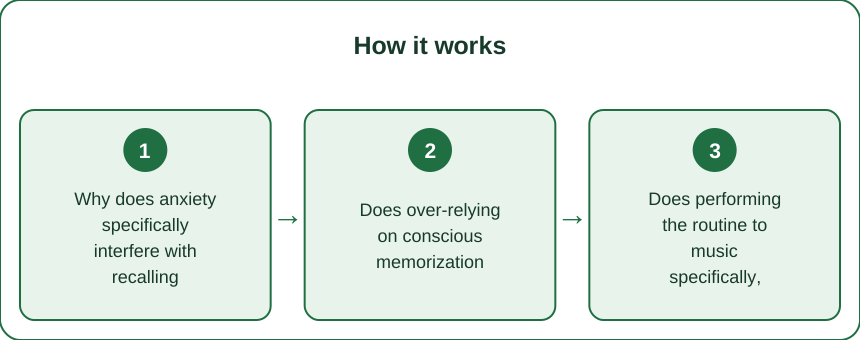
Why does anxiety specifically interfere with recalling something well-practiced, rather than just making the performance feel harder?
Acute stress diverts cognitive resources toward threat-monitoring (worrying about the audience, worrying about mistakes), which competes directly with the working memory resources needed to consciously retrieve a sequence — this is a well-studied effect across many skill domains, not specific to dance, and it explains why well-rehearsed material can feel momentarily inaccessible under pressure even though it’s genuinely still learned.
Does over-relying on conscious memorization (rather than physical muscle memory) make this worse?
Often yes — choreography learned primarily through conscious, step-by-step memorization is more vulnerable to this kind of pressure-induced blanking than choreography that’s been drilled enough to become more automatic, physically embodied movement, since automatic movement relies less on the same working-memory pathway that stress disrupts.
Does performing the routine to music specifically, versus counting it out, change how retrievable it is under pressure?
Frequently yes, and in a helpful direction — music provides an external rhythmic and structural cue that can support recall even when conscious memory falters, which is part of why many dancers who blank on a specific count can often recover and continue once they refocus on the music itself rather than the count.
Myth vs Fact: ‘If You Forget Choreography, You Didn’t Practice Enough’
Myth: blanking under pressure always means insufficient rehearsal. Fact: even extensively rehearsed, well-known material is genuinely vulnerable to pressure-induced retrieval failure — it’s a normal cognitive response to acute stress, and many experienced performers, including professionals, have experienced it despite thorough preparation.
FAQ: Choreography Memory Under Pressure Questions, Answered
Does rehearsing under simulated pressure (performing for friends, filming yourself) actually help reduce this?
Yes, considerably — deliberately practicing under conditions that create some of the same pressure response (an audience, being recorded, a single-take mentality) helps build tolerance and familiarity with performing under that specific stress state, which measurably reduces blanking risk over time.
Is there a specific technique to recover in the moment if a blank happens mid-performance?
Refocusing on the music and continuing with whatever movement feels natural, rather than stopping to consciously recall the exact missed step, tends to work better in the moment — many audiences don’t notice a small deviation nearly as much as a performer assumes.
Does this pressure-related memory issue improve with more overall performance experience over time?
Generally yes — repeated exposure to performance pressure, similar to any exposure-based tolerance building, tends to reduce both the frequency and severity of pressure-induced blanking as a dancer accumulates more real performance experience.
TL;DR:
- Blanking on choreography under pressure is a documented retrieval failure caused by acute stress, not lost learning
- Movement drilled into automatic muscle memory is more pressure-resistant than consciously memorized sequences
- Refocusing on the music, rather than the count, often supports recovery mid-performance
- Practicing under simulated pressure (an audience, being filmed) builds real tolerance over time
The choreography isn’t gone when you blank — it’s just temporarily hard to reach, and performance-pressure practice is what makes it easier to reach next time.
Keep Reading
This article is for general informational and styling purposes only. Fit, sizing, and product availability may vary.