Why You Learn Choreography Faster in Eight Counts Than Full Runs
Quick Answer: Eight-count practice beats full runs because motor learning depends on repetitions of the specific segment you cannot do yet. A full run gives you one attempt at the hard section and 30 attempts at parts you already know. Drill the weak eight counts 10 to 15 times each, then run the full song once at the end to test retention.
You have run the song eleven times today. You still cannot do the pre-chorus transition.
That is not a talent ceiling. It is an allocation problem — you gave the hard four seconds eleven attempts and the easy parts three hundred.
The fix is boring, unglamorous, and works within one session.
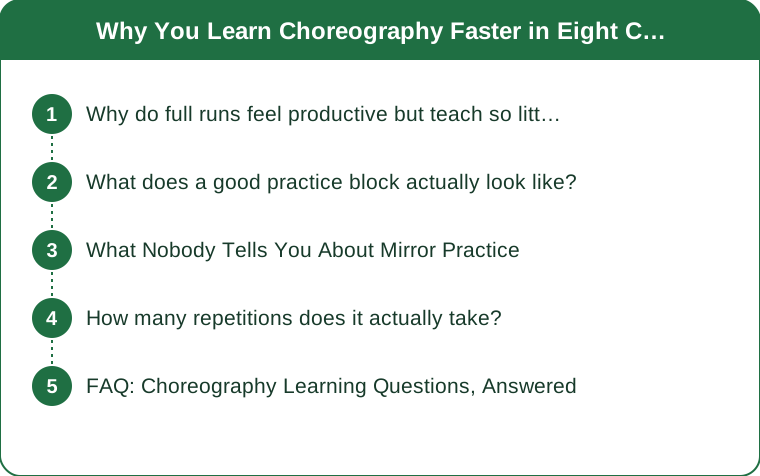
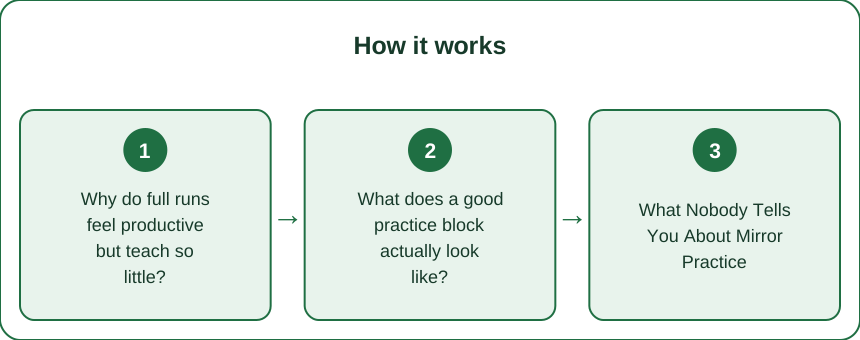
Why do full runs feel productive but teach so little?
Because they feel like the real thing, and effort feels like progress.
But motor learning is driven by repetitions of the specific movement pattern you have not yet automated. In a three-minute song with one difficult eight-count, a full run buys you roughly four seconds of relevant practice for three minutes of work.
Full runs also let you build in a compensation. When you hit the hard part and fudge it to stay on beat, you are practicing the fudge. Do that eleven times and the fudge becomes the version your body knows.
Full runs have exactly two good uses: testing retention at the end of a session, and building the stamina to perform the whole thing. Neither is learning.
What does a good practice block actually look like?
Structure a 45-minute session like this:
- 5 min warm-up, including the specific joints the choreo hammers — usually shoulders, neck, and hips for K-pop
- 25 min segment drilling. Pick the two weakest eight-counts. For each: 3 reps at half speed watching yourself, 5 reps at 75 percent, 5 reps at full speed, 2 reps facing away from the mirror
- 10 min transition drilling. Take the eight-count before and the eight-count after the hard part and drill only the seam. Transitions fail more often than the moves themselves
- 5 min one full run, recorded on your phone
- Watch the recording once before you leave
The half-speed reps are the ones people skip and the ones that matter most. You cannot clean at full speed what you cannot execute at half speed — full speed hides errors behind momentum.
What Nobody Tells You About Mirror Practice
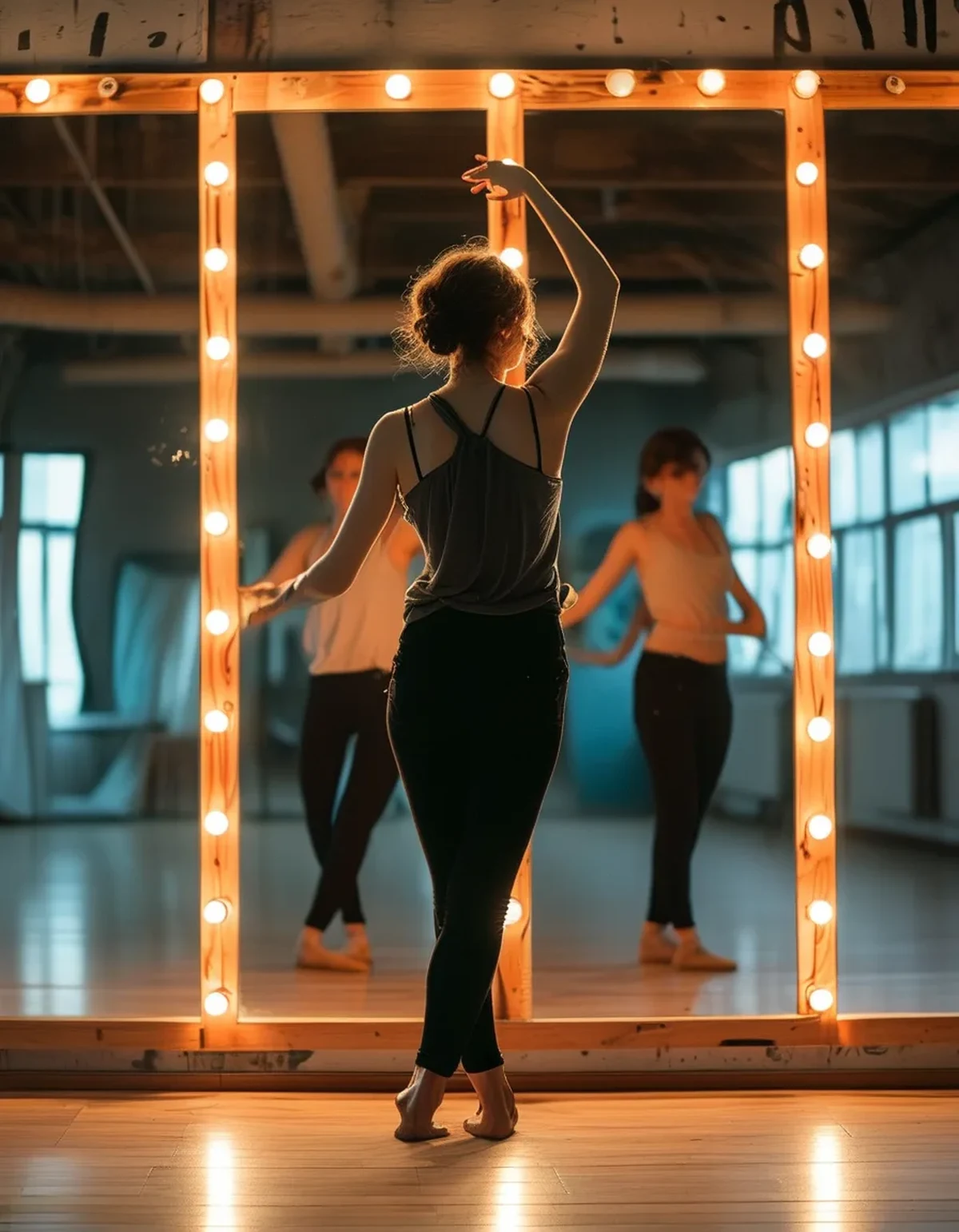
The mirror is a crutch that becomes a wall.
Practicing exclusively facing a mirror builds a visual dependency — you learn the move as a picture you are checking, not as a sensation you can reproduce. Then you perform without a mirror and it falls apart.
Two rules that fix it:
- Learn facing the mirror, clean facing away. Once you know the shape, turn around. If it survives without visual feedback, you actually own it.
- Record instead of watching live. Live mirror-watching pulls your head position and eye line off the choreography constantly. Recording lets you dance with correct focus and still get feedback.
There is a second hidden cost: mirrors flip you. If you learn a routine from a mirrored tutorial while facing a mirror, you have flipped it twice, and you will be unsure which hand starts for weeks. Pick one convention — most people use the mirrored tutorial view — and stay with it for the whole song.
How many repetitions does it actually take?
There is no universal number, but useful working figures from dance coaching practice:
- 10 to 15 clean reps of an eight-count in one session is enough for it to feel available the next day
- Three sessions across a week with sleep between them is when it starts to feel automatic — sleep consolidation matters more than total practice hours
- Practicing 20 minutes daily beats 2 hours on Sunday, consistently and by a wide margin
The word clean is doing the work in that first bullet. Fifteen sloppy reps at full speed reinforce sloppy. Aim for reps you would be willing to have filmed.
Also, stop before you get sloppy from fatigue. Practicing a movement badly at the end of a session can undo the good reps that came before it — the last version is disproportionately what sticks.
FAQ: Choreography Learning Questions, Answered
Should I learn the whole song first or perfect each section?
Learn the rough shape of everything first so you have a map, then drill sections. Perfecting section one before seeing section two makes it hard to feel how the piece flows.
Why can I do it alone but not in class?
Cognitive load. In class you are also tracking the instructor, other people, spacing, and self-consciousness. Solo drilling removes those, which is exactly why solo drilling should be where the learning happens.
How do I stop counting out loud in my head and just feel it?
Counting drops away on its own once the sequence is automated. Trying to abandon counting early usually causes timing drift. Let it go when it goes.
TL;DR:
- Full runs give the hard section almost no practice and let you rehearse compensations
- Drill weak eight-counts 10 to 15 clean reps, including half-speed and facing away from the mirror
- Drill the seams between sections, not just the sections
- Twenty minutes daily with sleep between sessions beats one long weekend block
Pick your single worst eight-count and give it fifteen reps tomorrow — nothing else. Most people find it unrecognizably better in one session, which tells you where the last month of full runs actually went.
Keep Reading
This article is for general informational and styling purposes only. Fit, sizing, and product availability may vary.