Why Perfect Footwork Still Looks Stiff Without This One Fix
Quick Answer: Your footwork isn’t the problem — the viewer’s eye tracks arms and hands far more than feet, so upper-body stiffness reads louder than a footwork slip ever would. The fix is joint isolation: learning to move the shoulder, elbow, and wrist as three separate points instead of one locked unit. Five focused minutes of slow isolation drills daily does more for how a cover looks than another full run-through.
You’ve drilled the counts. The footwork is exact. You watch the video back and it still looks… stiff. Robotic, somehow, even though nothing is technically wrong.
This is one of the most common plateaus in learning choreography, and almost everyone diagnoses it in the wrong place.
Why Doesn’t Perfect Footwork Look Fluid?
Because the camera isn’t looking at your feet, and neither is anyone watching.
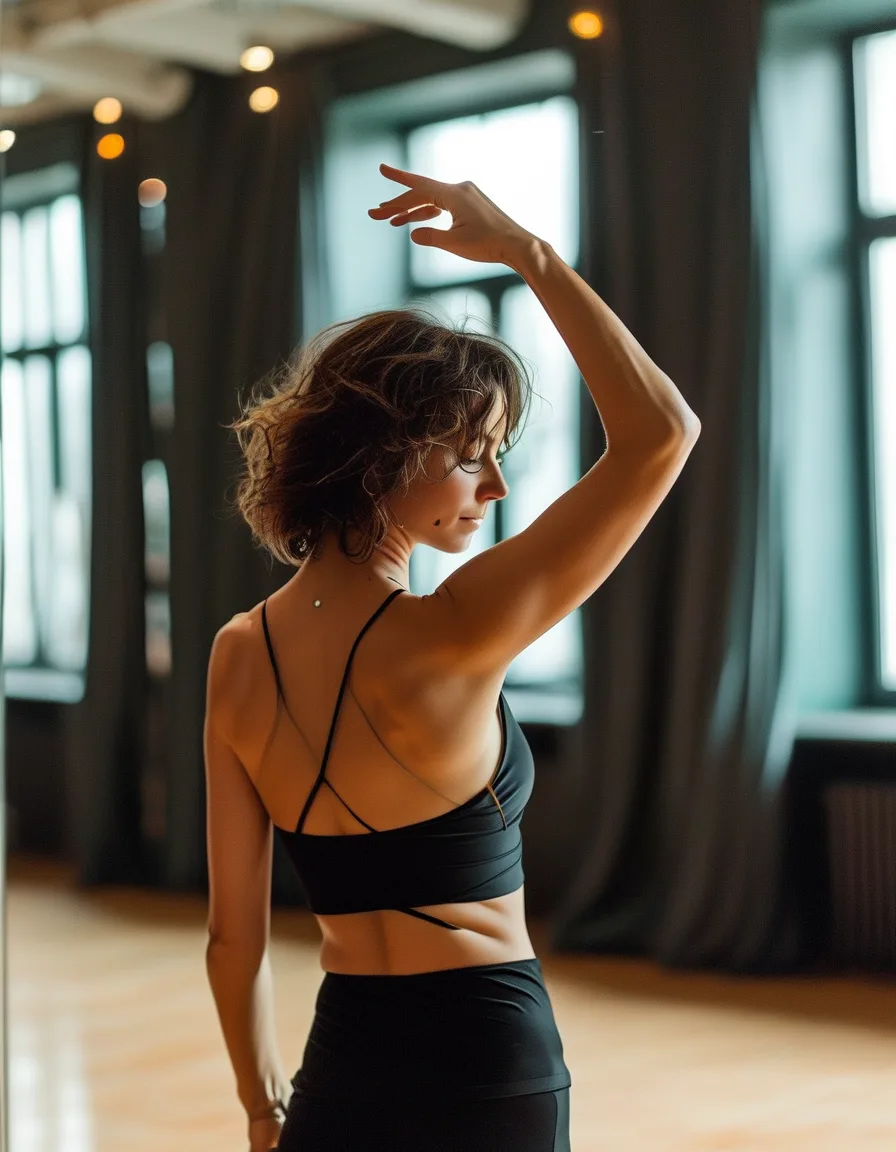
In any recorded dance cover, the viewer’s eye tracks the upper body — face, shoulders, arms, hands. That’s where attention naturally goes, partly because it’s where expression lives and partly because it’s usually the largest and fastest-moving part of the frame.
The practical consequence is a lopsided error budget. A small footwork mistake is genuinely hard to notice at full speed. Rigidity in your arms is visible in every single frame.
So dancers spend their practice time on the part of the body doing the least visual work, get it perfect, and can’t understand why the result still doesn’t read. Perfect footwork doesn’t translate into a fluid look because footwork was never the thing producing the look.
There’s a compounding factor too. When you’re concentrating hard on getting counts and steps right, you unconsciously tense your upper body — a normal cognitive-load response. The harder you focus on the feet, the stiffer the arms get.
What Is Joint Isolation, and Why Does It Fix This?
Stiff arms almost always mean the arm is moving as one rigid unit — shoulder, elbow, and wrist locked together, the whole limb swinging from the shoulder like a plank.
Fluid arms mean those three joints are moving as three separate, independently controllable points, usually in sequence rather than simultaneously.
That sequencing is the entire mechanism behind what looks like “flow.” An arm wave isn’t a mysterious talent — it’s fingers, then wrist, then elbow, then shoulder, each initiating a fraction of a beat after the last. Reverse the order coming back. That’s it.
Once you see it as a sequence rather than a quality, it stops being something some dancers just have and becomes a trainable motor skill, which is what it actually is.
The same principle governs sharp movement, not just smooth movement. Crisp K-pop choreography relies on isolating a shoulder pop from the rest of the torso, or a wrist flick from the forearm. Without isolation, everything moves together and the whole body reads as one blunt shape.
A 5-Minute Daily Isolation Drill
Do this before you touch any choreography. Slow. Every day beats long sessions occasionally — this is motor learning, and it responds to frequency.
Minute 1 — Shoulder isolation. Arms hanging relaxed. Lift one shoulder straight up, drop it. Roll it forward, back. Nothing else moves — not your head, not your elbow, not your ribs. Watch in a mirror and hunt for the cheating.
Minute 2 — Elbow isolation. Upper arm held still and horizontal, hinge only at the elbow. Then rotate the forearm — palm up, palm down — with the upper arm completely frozen.
Minute 3 — Wrist and hand. Wrist circles, both directions. Then flicks: sharp snap out, controlled return. Then finger rolls, pinky through to thumb. Hands are the most-watched and least-practised part of the body.
Minute 4 — The arm wave. Chain them. Fingers → wrist → elbow → shoulder, each one starting just after the last, at quarter speed. Then reverse: shoulder → elbow → wrist → fingers. It will look terrible for about a week. Then it won’t.
Minute 5 — Slow choreography arms. Take 8 counts from whatever you’re currently learning and do only the arms, at half speed, standing still. No footwork at all. This isolates the upper body from the cognitive load of the feet, which is where the tension was coming from in the first place.
Record minute 5 once a week. Isolation improvements are gradual enough that you won’t perceive them day to day, and obvious across two weeks of footage.
What Nobody Tells You About Looking Fluid
Tension in your hands gives everything away. Splayed, rigid fingers read as stiff no matter how good the arm path is. Relaxed hands with slight natural curve read as trained. It’s the cheapest upgrade available.
Fluidity is about the transitions, not the positions. Beginners hit the right shapes and travel between them in straight, uniform lines. Trained dancers vary the speed between shapes — slower into a position, faster out of it.
Sharpness needs isolation just as much as smoothness does. A shoulder pop only looks sharp if the rest of your torso stays completely still. Without isolation you get a whole-body jolt, which reads as clumsy rather than crisp.
Breathing matters. Holding your breath through 8 counts locks the shoulders and ribs. If your upper body goes rigid at exactly the hard part, check whether you’re breathing at all.
Neck and head count. Frozen head, moving body reads as robotic even with excellent arms. Let the head follow the movement.
FAQ
How long does it take to get less stiff?
Most people see a visible difference in two to three weeks of five-minute daily isolation work. It’s neural learning, so frequency matters far more than session length — five minutes daily beats an hour on Sunday.
Should I stop practising footwork?
No — keep it, just rebalance. A useful split is five minutes of isolation, then arms-only work on your current 8-counts, then the full choreography. The footwork will hold; it’s already the part you’ve over-practised.
Why do my arms look stiff only at full speed?
Because at speed you revert to what’s automatic, and the isolation isn’t automatic yet. Practising at half speed until it’s effortless is what makes it survive acceleration — speeding up too early just rehearses the stiff version.
TL;DR:
- The eye tracks arms and hands, not feet — upper-body stiffness reads loudest
- Concentrating hard on footwork actively tenses the upper body
- Stiff arms = shoulder, elbow, and wrist moving as one locked unit
- Fluidity is sequencing those three joints, and it’s a trainable skill
- 5 minutes daily: shoulder, elbow, wrist, arm wave, then arms-only choreography
- Relaxed hands are the cheapest upgrade available
- Record weekly — the change is invisible daily and obvious across two weeks
Keep Reading
This article is for general informational and styling purposes only. Fit, sizing, and product availability may vary.