Why Your Energy Drops at the Chorus You Know Best
Quick Answer: Repetition makes movement efficient, and efficiency means smaller ranges, less force, and less facial engagement. The chorus you have run two hundred times gets the least energy precisely because it costs you the least. Fix it by practising the chorus at deliberately exaggerated size, recording it separately from the full run, and treating energy as a trained skill rather than a performance mood.
You know the chorus better than anything else in the song.
On video it is the section that looks the most tired, and that is not a coincidence - it is what practice does when nobody corrects for it.
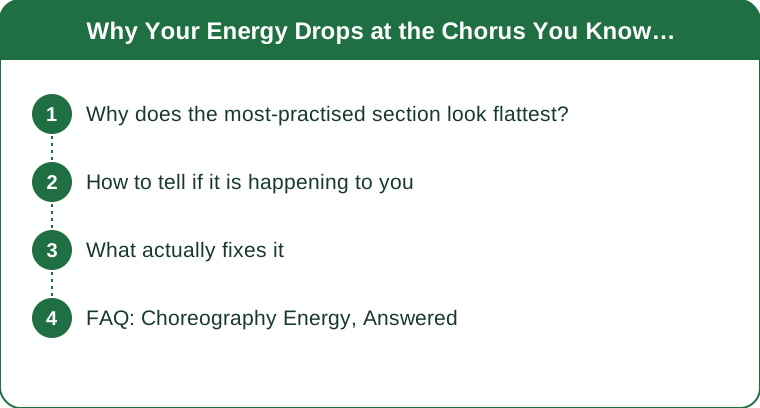
Why does the most-practised section look flattest?
Your body optimises for efficiency, not for impact. Repetition trims every movement toward the smallest version that still counts as the move, because that is what motor learning does.
Efficiency is exactly wrong for performance. Choreography reads on camera through range, sharpness, and the force behind a movement - all of the things efficiency removes first.
Attention drops with familiarity too. The chorus no longer requires thought, so you stop actively driving it and it runs on autopilot, which looks precisely like autopilot from the outside.
Facial expression fades before the body does. Expression is the first thing to disappear when a section becomes automatic, and it is the single biggest difference between a cover that reads as flat and one that does not.
Fatigue lands here as well. The chorus usually arrives after the most demanding sections, so it gets both the familiarity discount and the tired body.
The verse, meanwhile, still gets full effort because it is less familiar and still requires attention - which is why so many covers have the strange quality of building down instead of up.
How to tell if it is happening to you
Record the chorus in isolation, then inside a full run, and compare. If the isolated version has visibly more range and expression, familiarity and fatigue are both costing you.
Watch the video with the sound off. Without the music carrying the energy, the flat sections are immediately obvious - this is close to how a judge or an algorithm sees it.
Check your arm end points specifically. Compare your extension in the first run of a session to the tenth. Most people lose 10 to 20 percent of range without noticing any difference in effort.
Look at your face in the mirror during the chorus. If your expression is neutral while your body is dancing, that is the gap, and it is the fastest one to fix.
Ask where your eyes are. Autopilot sections almost always come with unfocused eyes or eyes that drop to the floor, and that reads as disengagement on camera even when the movement is correct.
Compare your version to the original side by side at the chorus only. The size difference is usually more obvious than the timing difference, and size is what most people underestimate.

What actually fixes it
Practise the chorus at 120 percent size. Deliberately overshoot every extension in rehearsal, because the version that survives into performance is always smaller than the version you practise.
Rehearse the chorus first, when you are fresh, rather than always reaching it at the end of a full run. Running the song in order every time means one section always gets your tired body.
Separate energy practice from accuracy practice. Do a run where you deliberately ignore precision and go for maximum size and expression, and a separate run for cleanliness. Trying to do both at once usually produces neither.
Practise the face on its own. Do the chorus with expression only - correct facial performance, minimal body - until the expression is as automatic as the choreography.
Record every session, even briefly. The gap between how a section feels and how it looks is the entire problem, and only video closes it.
Add a physical cue for the chorus start. A sharper breath, a deliberate reset of the shoulders, a specific eye focus point - something that tells your body a new section has begun rather than letting it flow through on autopilot.
And build the stamina for it, since some of this is genuinely conditioning. If you cannot hold full size for a three-minute song, the answer is cardio and repetition at full size, not more accuracy work.
FAQ: Choreography Energy, Answered
Why does the section I know best look worst on video?
Because repetition optimises for efficiency, which shrinks range and force, and familiarity reduces active attention. Both are exactly the qualities performance needs most.
How much bigger should I practise than perform?
Around 120 percent of the size you want to see. The performed version is reliably smaller than the rehearsed one, so rehearsing at the target size lands below it.
Why does my face go blank in the chorus?
Expression is the first thing to become automatic and therefore the first to fade. Practise the chorus with expression only, no full body, until the face is as trained as the movement.
Should I always run the song from the start?
No. Always starting at the beginning means the later sections always get your tired body. Rotate which section you rehearse first when fresh.
How often should I record myself?
Every session, even for thirty seconds. The gap between how a section feels and how it looks cannot be closed any other way.
Is this a stamina problem or a habit problem?
Usually both. If you cannot maintain full size for a whole song, add conditioning; if the size disappears in the sections you know best regardless of fatigue, it is the familiarity effect.
Does watching with the sound off really help?
Yes, considerably. Music carries energy that the movement is not actually producing, and muting it shows you what the camera sees rather than what you feel.
TL;DR:
- Repetition optimises movement for efficiency, which shrinks range, force, and expression - the exact qualities performance depends on.
- The chorus gets both the familiarity discount and your most tired body, since it usually comes after the hardest sections.
- Facial expression fades before the body does, and it is the fastest thing to fix.
- Practise at 120 percent size, rehearse the chorus first when fresh, and separate energy runs from accuracy runs.
- Record every session and watch it with the sound off to see what the camera sees.
Add a physical cue at the chorus start - a sharp breath or a shoulder reset - so your body registers a new section instead of coasting.
Keep Reading
This article is for general informational and styling purposes only. Fit, sizing, and product availability may vary.